
Table of Contents
- What Is Proactive Mechanical Maintenance?
- Key Benefits of Proactive Mechanical Maintenance
- Proactive vs. Preventive vs. Reactive Maintenance
- Cost Savings from Proactive Maintenance Programs
- Predictive Maintenance Technology in Canada
- Implementing Proactive Maintenance in Canadian Facilities
- Sustainability and Energy Efficiency Benefits
- Conclusion
Last Updated: July 23, 2026
What Is Proactive Mechanical Maintenance?
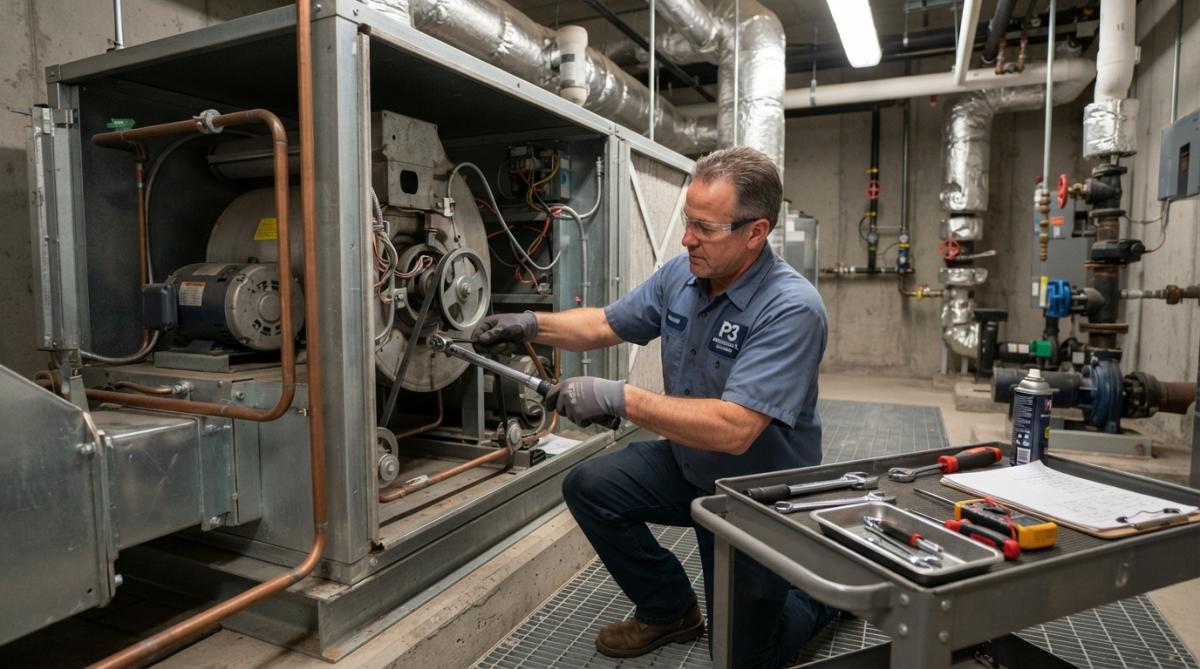
Proactive mechanical maintenance refers to scheduled, planned upkeep performed on equipment before problems occur, rather than waiting for breakdowns to happen. This approach combines regular inspections, preventive servicing, and condition monitoring to keep systems running smoothly. At P3 MECHANICAL & ELECTRICAL, we’ve seen firsthand how the benefits of proactive mechanical maintenance transform facility operations across residential and commercial properties on Vancouver Island.
Unlike reactive maintenance, which responds to failures after they happen, proactive strategies prevent issues from developing in the first place. A technician might identify a worn bearing during a scheduled inspection and replace it before it fails catastrophically. Most mechanical systems show warning signs weeks or months before complete failure, vibration increases, temperature creeps up, efficiency drops.
The real advantage of proactive maintenance isn’t eliminating all breakdowns, it’s controlling when they happen. You schedule repairs on your timeline, not the equipment’s emergency timeline.
Key Benefits of Proactive Mechanical Maintenance
Organizations that implement structured maintenance programs see measurable improvements across safety, operational efficiency, and financial performance.
1. Prevent Unplanned Downtime and Equipment Failure
Unplanned downtime represents one of the costliest consequences of reactive maintenance. When an HVAC system fails during winter or a commercial plumbing line ruptures during business hours, operations halt immediately. Proactive maintenance prevents these scenarios by identifying and resolving issues before they escalate. A technician performing a scheduled inspection might discover a refrigerant leak, worn compressor bearings, or a failing motor capacitor, all addressable before catastrophic failure occurs.
2. Extend Asset Lifespan and Maximize Equipment Uptime
Equipment has a designed service life. An HVAC system rated for 15 years might last only 10 if neglected, or stretch to 18 years with proper maintenance. Proactive maintenance extends asset lifespan by reducing stress on equipment. Clean filters mean compressors work less hard. Proper lubrication reduces bearing wear. For property owners, extending equipment life by even two or three years represents substantial savings, a commercial boiler replacement might cost tens of thousands of dollars.
Equipment operating under optimal conditions lasts measurably longer than equipment running in degraded states. Proactive maintenance keeps systems in that optimal zone.
3. Reduce Total Maintenance Costs
The total maintenance cost of equipment includes both planned maintenance expenses and emergency repair expenses. Most organizations underestimate how much unplanned maintenance costs because emergency expenses get absorbed across different budget categories, overtime labor, expedited parts, emergency service premiums, and lost productivity.
Proactive maintenance shifts spending toward planned, scheduled work that’s cheaper to execute. A technician replacing a worn component during a scheduled visit charges standard rates. That same technician called for an emergency repair charges premium rates, often with travel surcharges and after-hours fees. Organizations that transition from reactive to proactive maintenance typically see total maintenance costs stabilize or decline within the first year, despite spending more on scheduled inspections.
4. Improve Safety and Ensure Compliance
Mechanical systems that deteriorate without maintenance create safety hazards. A failing HVAC system might distribute contaminated air. Corroded plumbing could introduce hazardous substances. Canadian building codes and fire safety standards require regular maintenance of critical systems. Proactive maintenance programs create the audit trails and service records that prove compliance while protecting occupants by ensuring fire suppression systems function during emergencies and preventing water contamination.
5. Boost Operational Efficiency
Equipment operating in poor condition consumes more energy and delivers reduced output. A dirty HVAC filter forces the system to work harder, increasing energy consumption. Proactive maintenance restores equipment to peak efficiency, ensuring systems deliver designed performance while consuming designed energy levels. For commercial facilities with significant mechanical loads, the energy savings from efficient equipment operation often justify the maintenance program cost within the first few years.
Proactive vs. Preventive vs. Reactive Maintenance
These three maintenance approaches represent different philosophies about when and how to service equipment.
Reactive maintenance waits for equipment to fail, then repairs it. This approach minimizes upfront maintenance spending but maximizes emergency expenses, downtime, and safety risks.
Preventive maintenance follows a fixed schedule regardless of equipment condition. Technicians perform oil changes, filter replacements, and inspections at predetermined intervals. This approach reduces emergency repairs compared to pure reactive maintenance but doesn’t account for actual equipment condition.
Proactive maintenance combines scheduled service with condition monitoring. Technicians inspect equipment regularly, assess actual wear and degradation, and adjust maintenance schedules based on what they find. This data-driven approach optimizes maintenance timing and prevents failures while avoiding unnecessary service on equipment still in good condition.
| Maintenance Type | When Work Happens | Cost Profile | Downtime Risk | Best For |
|---|---|---|---|---|
| Reactive | After failure occurs | High emergency costs | Very high | Non-critical systems only |
| Preventive | Fixed schedule | Moderate, predictable | Low to moderate | Standard equipment with known wear patterns |
| Proactive | Based on condition data | Optimized, lower overall | Very low | Critical systems, complex facilities |
Reactive maintenance seems cheaper until an emergency repair causes unplanned downtime. A $500 preventive bearing replacement prevents a $15,000 emergency failure and multi-day facility shutdown.
Cost Savings from Proactive Maintenance Programs
The financial case for proactive maintenance becomes clear when you account for all costs involved in equipment operation. Consider a commercial HVAC system. A scheduled maintenance visit costs $300-500 and takes 2-3 hours. An emergency repair for a compressor failure might cost $3,000-5,000 plus same-day service surcharges. Over a 15-year period, the proactive approach costs $24,000 in planned maintenance but avoids roughly $20,000 in emergency repairs and energy overages.
Energy efficiency improvements from proactive maintenance compound these savings. A well-maintained HVAC system consumes 10-15% less energy than a neglected system. For a commercial facility with $50,000 annual energy costs, this represents $5,000-7,500 in yearly utility savings. Over 15 years, that’s $75,000-112,500 in energy savings alone.
Predictive Maintenance Technology in Canada
Modern predictive maintenance combines condition monitoring with data analytics to forecast equipment failures before they occur. IoT sensors attached to equipment measure temperature, vibration, pressure, and other parameters. When sensor readings deviate beyond normal ranges, the system alerts maintenance teams that failure risk is elevated.
Predictive maintenance works particularly well for high-value equipment where failure costs are substantial. However, it requires initial investment in sensors, connectivity infrastructure, and software subscriptions. Small facilities and residential properties typically find the investment difficult to justify unless equipment failure creates severe operational impact. A balanced approach uses continuous monitoring on critical systems while relying on scheduled inspections for standard equipment.
Implementing Proactive Maintenance in Canadian Facilities
Transitioning from reactive to proactive maintenance requires planning, training, and organizational commitment.

Build a Maintenance Strategy with CMMS/EAM Integration
A maintenance strategy defines which equipment receives proactive attention, what maintenance activities occur, and how frequently service happens. Start by inventorying all mechanical systems in your facility. For each system, document its criticality, how much does failure impact operations? Systems with higher criticality warrant more frequent proactive maintenance.
Establish baseline maintenance schedules based on manufacturer recommendations and industry standards. HVAC systems typically receive inspection and filter changes every 3-6 months. Plumbing systems benefit from annual inspections for leaks and corrosion. These baselines provide starting points; actual intervals adjust based on observed equipment condition.
Computerized Maintenance Management Systems (CMMS) and Enterprise Asset Management (EAM) software transform maintenance strategy from paper-based chaos into organized, trackable programs. These platforms store equipment inventories, maintenance histories, inspection checklists, and work orders. Popular Canadian platforms include Maximo, SAP, Fiix, and Hippo CMMS.
Address the Skill Gap and Train Your Team
Proactive maintenance requires technicians with assessment skills, not just repair skills. A reactive maintenance technician arrives after failure and fixes the broken component. A proactive technician arrives before failure, identifies degrading components, and determines which ones need replacement now versus which ones can continue operating safely.
Training approaches include formal certification programs through organizations like HVAC Excellence or the Refrigeration Service Engineers Society, online courses covering condition assessment techniques, and on-the-job mentoring where experienced technicians teach newer staff.
Manage Change and Build a Proactive Culture
The transition from reactive to proactive maintenance represents organizational change. Staff accustomed to responding to emergencies must shift to planning ahead. Successful implementation requires clear communication about why the change matters. When staff understand the cost and disruption of reactive maintenance, the emergency repair bills, the unplanned downtime, the safety risks, they support the transition.
Building a proactive culture means celebrating prevented breakdowns as much as celebrating quick repairs and tracking metrics about maintenance effectiveness.
Sustainability and Energy Efficiency Benefits
Proactive mechanical maintenance delivers environmental benefits that often go unrecognized in traditional cost-benefit analyses. Well-maintained equipment operates more efficiently, consuming less energy and producing fewer emissions. An HVAC system operating with clean filters, properly calibrated controls, and well-maintained refrigerant charge consumes significantly less energy than a neglected system, the efficiency difference might be 10-20%.
For commercial buildings where HVAC represents 40-50% of energy consumption, this efficiency improvement translates to measurable reductions in overall facility energy use. Proactive maintenance also extends equipment lifespan, reducing the frequency of equipment replacement and the manufacturing-related environmental impact that accompanies new equipment production.
Conclusion
The benefits of proactive mechanical maintenance extend across financial performance, operational reliability, safety compliance, and environmental impact. Organizations that shift from reactive to proactive approaches consistently report lower total maintenance costs, higher equipment reliability, improved safety outcomes, and reduced energy consumption.
Implementing proactive maintenance requires investment in planning, training, and systems integration. It demands organizational commitment to change established patterns and embrace prevention-focused thinking. But the payoff justifies the effort, facilities operating proactive maintenance programs enjoy predictable budgets, reliable systems, and significantly lower emergency expenses.
If your facility struggles with frequent equipment breakdowns, unpredictable maintenance expenses, or safety compliance concerns, proactive maintenance offers a proven solution. P3 MECHANICAL & ELECTRICAL specializes in developing and implementing proactive maintenance programs for residential and commercial properties across Vancouver Island. Our certified technicians perform thorough condition assessments, identify equipment degradation early, and help you establish maintenance strategies that prevent failures before they happen. We integrate with CMMS platforms, provide technician training, and support the organizational change required for successful implementation. Get a quote from P3 MECHANICAL & ELECTRICAL today and discover how proactive maintenance can transform your facility’s reliability and reduce your total maintenance costs.
Frequently Asked Questions
What is the difference between proactive and reactive maintenance?
Proactive maintenance involves scheduled inspections and preventive actions to avoid equipment failure before it occurs. Reactive maintenance addresses problems only after they happen, leading to unplanned downtime and higher costs. Proactive approaches use condition monitoring and predictive analytics to maintain asset reliability, while reactive maintenance is typically emergency-driven and disruptive to operations.
How does proactive maintenance save money?
Proactive maintenance reduces total maintenance costs by preventing costly equipment failures and unplanned downtime. Scheduled inspections identify minor issues early, avoiding expensive emergency repairs. It also extends asset lifespan, reduces labor costs through efficient planning, and minimizes production interruptions. Organizations typically see significant ROI within the first year by shifting from reactive to proactive strategies.
How can Canadian businesses implement proactive mechanical maintenance?
Start by assessing your current equipment and creating a maintenance strategy aligned with manufacturer recommendations. Integrate a CMMS or EAM system to track scheduled inspections and sensor data. Train your maintenance technicians on condition monitoring techniques and predictive analytics. Address cultural change by emphasizing the long-term benefits of asset reliability. For facilities in coastal areas like Vancouver Island, account for salt air and humidity impacts on equipment performance.
What technologies support proactive maintenance in Canada?
IoT sensors and condition monitoring devices track machine health in real-time, feeding data into CMMS and EAM platforms for analysis. Predictive analytics software identifies patterns that signal equipment failure before it occurs. Mobile applications enable maintenance technicians to access work orders, historical data, and compliance records on-site. These tools improve maintenance planning, reduce downtime, and support data-driven decisions across your asset lifecycle.
This article was written using GrandRanker
Leave a Reply