
Table of Contents
- Why Is My Furnace Blowing Cold Air? Common Causes
- Step 1: Check Your Air Filter and Clean or Replace It
- Step 2: Verify Thermostat Settings for Furnace Operation
- Step 3: Inspect the Pilot Light and Ignition System
- Step 4: Check for Gas Supply and Flame Sensor Problems
- Step 5: Clear a Clogged Condensate Drain
- DIY vs. Professional Safety Thresholds
- Furnace Maintenance Tips Canada: Prevent Cold Air Issues
Furnace Blowing Cold Air? 7 Fixes to Restore Heat
Last Updated: July 25, 2026
Why Is My Furnace Blowing Cold Air? Common Causes
If your furnace is blowing cold air, you’re experiencing one of the most frustrating heating problems a homeowner can face, especially during Canadian winters. At P3 MECHANICAL & ELECTRICAL, we’ve diagnosed this issue hundreds of times across Nanaimo and Vancouver Island, and the good news is that most causes are fixable without a full system replacement. Cold air typically signals a clogged air filter, thermostat set to the wrong mode, a failed ignition system, or a problem with the gas supply or flame sensor.
When you turn up your thermostat, your furnace goes through a diagnostic cycle: the ignition system fires up, the burners ignite, the heat exchanger warms up, and only then does the blower motor push heated air through your ductwork. If any component fails, you’ll feel cold air.
Before you panic, know that furnace blowing cold air problems rarely mean your entire system is broken. Most homeowners can address 3-4 of the fixes below without special tools. Start with the air filter and thermostat settings, these account for roughly 40% of cold air complaints we see.
Understanding the Furnace Startup Sequence
When the thermostat calls for heat, the furnace’s safety system checks whether the pilot light is burning (on older models) or whether the ignition system can spark (on newer units). If that check passes, the gas valve opens and fuel flows to the burners. The flame sensor verifies that combustion is occurring. Only after the heat exchanger reaches a certain temperature does the blower motor activate to push warm air into your home.
If cold air is blowing instead of hot air, the most likely culprit is that the heat exchanger never reaches the temperature threshold needed to trigger the blower. This can happen because the burners aren’t igniting, the pilot light has gone out, the flame sensor is dirty, or the gas supply is interrupted. When you first turn up the thermostat, you may hear the furnace kick on but feel no warm air for 30-60 seconds. This is normal. If this delay stretches to several minutes, or if you never feel warm air at all, one of the problems below is likely the cause.
Step 1: Check Your Air Filter and Clean or Replace It
A dirty air filter is the single most common reason furnaces blow cold air, yet it’s also the easiest fix. When your air filter becomes clogged with dust, pet hair, and debris, airflow through the furnace is severely restricted. Many furnaces have a limit switch that prevents the blower from running if airflow is too restricted, to avoid overheating the system. A clogged filter can trigger this limit switch, causing the blower to shut off entirely or run intermittently.

Replacing your air filter takes five minutes and costs nothing if you already have a replacement on hand. Most residential furnaces use 1-inch or 4-inch filters that slide into a slot near the return air ductwork or the furnace cabinet itself. You’ll know the filter is dirty if it’s visibly gray or brown instead of white, or if you can’t see light through it when you hold it up to a window.
How to Inspect and Replace Your Filter
-
Turn off your furnace at the thermostat or the power switch on the unit itself.
-
Locate the filter slot. Most furnaces have a filter rack mounted on the return air duct or on the side of the furnace cabinet.
-
Note the filter dimensions printed on the frame or the old filter itself (typically 16x25x1, 20x25x1, 16x25x4, or 20x25x4 inches).
-
Remove the old filter by sliding it out of the slot or unclipping the frame. Inspect it: if it’s visibly clogged, dark, or holding together barely, replacement is overdue.
-
Install the new filter with the arrow on the frame pointing toward the furnace (this indicates airflow direction). Slide it in fully and secure the clips or frame.
-
Turn the furnace back on and listen for the blower to resume operation within 30-60 seconds.
If you’ve replaced the filter and still feel cold air, move to the next step.
Do NOT run your furnace without a filter. The filter protects the blower motor and heat exchanger from dust accumulation. Without it, debris clogs the system and shortens its lifespan by years. Always keep a replacement filter on hand during heating season.
Step 2: Verify Thermostat Settings for Furnace Operation
Many homeowners discover their furnace is blowing cold air only to realize the thermostat is set to the wrong mode. Modern thermostats have at least two fan settings: Auto and On. When set to "Fan: On," the blower motor runs continuously, pushing air through the ductwork whether the furnace is heating or not. If the burners aren’t actively heating, you’ll feel cold air. When set to "Fan: Auto," the blower runs only when the heat exchanger is hot enough to warm the air.
Check your thermostat display. If it shows "Fan: On," switch it to "Fan: Auto." Give the furnace 2-3 minutes to cycle. You should hear the burners ignite, then feel warm air within 60-90 seconds. Also verify that the mode is set to "Heat" and not "Cool" or "Off." If your smart thermostat is showing a heating setpoint of 18°C (65°F is approximately 18.33°C) but your home is currently 20°C (68°F is approximately 20°C), the furnace won’t run. Adjust the heating setpoint to a temperature higher than your current home temperature.
The furnace blowing cold air is often just a thermostat setting issue. Verify Fan: Auto and Heat mode before assuming there’s a mechanical problem. This single check resolves roughly 20% of cold air complaints.
Step 3: Inspect the Pilot Light and Ignition System
Older furnaces rely on a standing pilot light, a small flame that burns continuously and ignites the main burners when the thermostat calls for heat. If this pilot light goes out, the furnace cannot ignite, and no heat is produced. Newer furnaces use electronic ignition systems (hot surface igniters or spark igniters) instead of pilot lights. Both systems can fail, resulting in furnace blowing cold air.
To check a pilot light, look for a small window on the front of your furnace. You should see a blue flame about the size of a pea. If there’s no flame, the pilot has gone out. For a standing pilot, locate the pilot control knob (usually labeled Pilot, Off, and On). Turn it to Off and wait 5 minutes. Then turn the knob to Pilot and hold it down while using a long lighter or match to ignite the flame at the pilot burner opening. Once lit, hold the knob down for another 30-60 seconds to heat the thermocouple. Release the knob; if the flame stays lit, turn the knob to On. If the pilot won’t stay lit, the thermocouple likely needs replacement, which requires a professional.
For electronic ignition systems, you won’t see a pilot light. Instead, you may hear a clicking sound when the furnace tries to ignite. If you hear repeated clicking but no ignition, look for a reset button (usually red or black) on the furnace cabinet and press it once. Wait 30 seconds and see if the furnace attempts to ignite again.
Step 4: Check for Gas Supply and Flame Sensor Problems
If the pilot light stays lit but the main burners won’t ignite, or if the burners ignite briefly then shut off, the problem is likely a gas supply issue or a faulty flame sensor. The flame sensor is a small rod that sits in the burner flame and confirms combustion is occurring. If the sensor is dirty, covered in soot, or misaligned, it sends a false signal that the burners have failed to ignite, causing the furnace to shut down as a safety measure.
Check whether other gas appliances in your home (stove, water heater, fireplace) are working. If they are, your gas supply is fine. To check the flame sensor, look for a thin metal rod (about the diameter of a pencil) positioned in the burner flame. If it’s visibly covered in soot or rust, carefully remove it and clean it with fine-grit sandpaper or a soft cloth. Reinstall it in the same position. Do not bend it or force it; improper positioning will prevent it from sensing the flame.
Never attempt to adjust gas lines, the gas valve, or the ignition system without professional training. Gas leaks are life-threatening. If you smell gas, leave your home immediately and call your gas provider’s emergency line.
Step 5: Clear a Clogged Condensate Drain
High-efficiency furnaces (those rated 90% AFUE or higher) produce condensation as a byproduct of combustion. This condensation drains through a small plastic line (usually about 3/8 inch in diameter) that runs from the furnace to a floor drain or to the outside. If this condensate drain becomes clogged with algae, dust, or mineral buildup, water backs up inside the furnace. Some furnaces have a safety switch that shuts down the system if water accumulates, preventing damage but also stopping heat production.
To check the condensate drain, locate the small plastic line running from the furnace and follow it to where it terminates. Look for water pooling around the furnace or near the drain exit. Clearing a clogged condensate drain is straightforward. Locate where the drain line connects to the furnace and disconnect it (have a small bucket ready to catch residual water). Use a straightened wire coat hanger or a plumbing snake to push through the line and dislodge the clog. Alternatively, pour a cup of white vinegar down the drain line to dissolve algae buildup, then flush it with warm water. Reconnect the line and ensure it slopes slightly downward toward the drain to promote water flow.
DIY vs. Professional Safety Thresholds
You can safely diagnose and fix air filters, thermostat settings, and condensate drains yourself. These tasks require no special tools and pose no safety risks.
Call a professional if:
- The pilot light won’t stay lit after relighting
- The electronic ignition clicks repeatedly but doesn’t ignite
- You suspect a gas leak (smell rotten eggs or mercaptan near the furnace)
- The flame sensor is visibly damaged or bent
- Water is pooling inside the furnace cabinet
- The furnace shuts down after running for a few minutes
- You hear a loud boom or pop when the furnace ignites
- The furnace produces an unusual smell (like burning plastic or metal)
You can handle yourself:
- Replacing the air filter
- Adjusting thermostat settings (Fan mode, Heat mode, setpoint temperature)
- Relighting a standing pilot light
- Cleaning the condensate drain line
- Pressing the reset button on the furnace
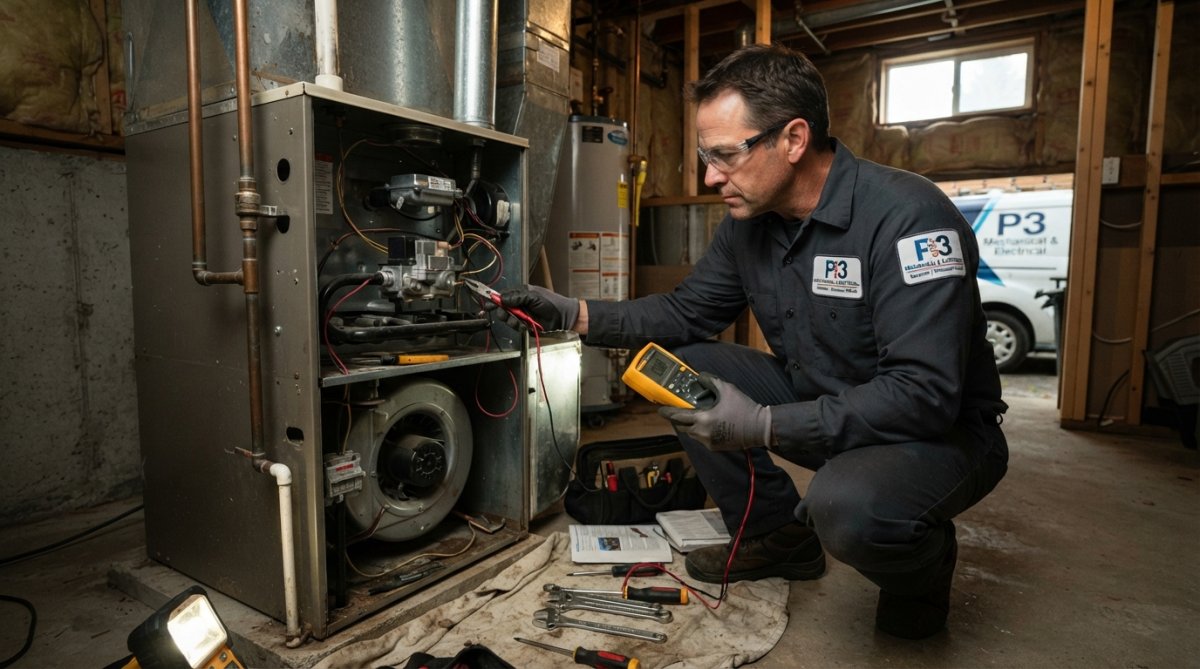
Professional HVAC technicians have diagnostic tools (multimeters, combustion analyzers, infrared thermometers) that allow them to identify problems quickly and safely. In Canada, many provinces require HVAC work to be performed by licensed technicians, especially when gas or electrical connections are involved.
Furnace Maintenance Tips Canada: Prevent Cold Air Issues
The best way to avoid furnace blowing cold air is preventive maintenance. A well-maintained furnace runs reliably and efficiently. Professional maintenance typically includes cleaning the burners, inspecting the heat exchanger for cracks, testing the safety switches, and ensuring the blower motor runs smoothly. Many Canadian homeowners schedule annual furnace maintenance in the fall, before heating season begins.
Between professional visits, check your air filter monthly during heating season (November through March) and replace it if it looks dirty. Ensure that your furnace has adequate clearance, at least 3 feet of space on all sides for proper ventilation and airflow. Keep the area around your furnace clean and dry, free of clutter that could obstruct air intake or exhaust vents.
Seasonal Maintenance Checklist
| Task | Timing | DIY or Pro | Impact |
|---|---|---|---|
| Replace air filter | Monthly (heating season) | DIY | Prevents airflow restriction and cold air |
| Inspect pilot light or ignition | Fall (before heating season) | DIY (pilot only) | Ensures furnace can ignite reliably |
| Clean condensate drain | Fall and spring | DIY | Prevents water backup and system shutdown |
| Professional furnace inspection | Fall (once per year) | Professional | Identifies cracks, gas leaks, and component failures early |
| Test thermostat settings | Fall and winter | DIY | Confirms furnace responds to temperature changes |
| Check furnace clearance and venting | Fall | DIY | Ensures proper airflow and safety |
In fall, when you first turn on the furnace after months of summer dormancy, run it for 10-15 minutes and smell near the vents. A slight burning smell (like dust being burned off) is normal. A strong chemical smell or smoke is not; turn off the furnace and call a technician. For homeowners on Vancouver Island, the salt air and high humidity can accelerate corrosion of furnace components. If you live near the coast, professional inspection every 18 months (instead of annually) is wise.
Many Canadian homeowners overlook the importance of ductwork maintenance. Leaky ducts allow heated air to escape into walls, attics, and crawlspaces, reducing the amount of warmth that reaches your living spaces. If you notice that certain rooms stay cold while others are warm, ductwork leaks or blockages may be the culprit. A professional can use thermal imaging to identify leaks and seal them with mastic sealant or metal tape.
If your furnace is blowing cold air and the basic troubleshooting steps above haven’t resolved the issue, the problem likely requires professional diagnosis. P3 MECHANICAL & ELECTRICAL provides expert furnace repair across Nanaimo and Vancouver Island, with certified technicians available for same-day service during heating season. Our team conducts a thorough inspection to identify whether the issue is a dirty flame sensor, a failed ignition system, a cracked heat exchanger, or a gas supply problem. We also handle furnace maintenance programs designed to prevent breakdowns and extend system lifespan. Get a quote from P3 MECHANICAL & ELECTRICAL today and restore warmth to your home before winter temperatures drop further.
Frequently Asked Questions
Why is my furnace blowing cold air but the fan is running?
Your furnace may be in its startup sequence, which can take several minutes as the heat exchanger warms. A dirty air filter can also restrict airflow and delay heating. If cold air persists beyond 10-15 minutes, check your thermostat fan mode (ensure it's on Auto, not On), inspect your air filter, and verify the pilot light or ignition system is functioning. If the issue continues, your flame sensor or gas valve may need professional inspection.
Can a dirty furnace filter cause cold air to blow from my vents?
Yes. A clogged air filter restricts airflow through your HVAC system, which can prevent warm air from circulating efficiently and cause the furnace to cycle improperly. This is one of the most common reasons for cold-air complaints. Inspect your filter monthly and replace it every 1-3 months, depending on household dust levels and pet presence. Furnace filter replacement in Canada is straightforward and often the first troubleshooting step.
How do I know if I should call a professional or fix it myself?
Replace air filters, adjust thermostat settings, and check the condensate drain yourself. However, stop immediately if you suspect gas supply issues, pilot light or ignition problems, flame sensor faults, or heat exchanger damage. Do not attempt to relight a pilot light repeatedly or manipulate gas valves, these require a certified HVAC technician. If your furnace is under warranty, professional service may be required. When in doubt, contact a licensed technician to avoid safety risks and equipment damage.
What is the normal furnace startup delay before warm air flows?
Most furnaces have a furnace startup delay of 5-15 minutes as the ignition system fires and the heat exchanger warms up. During this time, the blower motor may run but deliver cool or lukewarm air. This is normal. However, if cold air persists beyond 15 minutes, or if your furnace fails to ignite, check your thermostat settings, air filter, and pilot light. Repeated cold-air cycles may indicate a limit switch, thermocouple, or combustion issue requiring professional diagnosis.
This article was written using GrandRanker
Leave a Reply