
Table of Contents
- The Case for Coastal HVAC Maintenance: What Salt Air Actually Does
- Salt Air Corrosion HVAC Protection: Why Standard Maintenance Isn’t Enough
- Cost-Benefit Analysis: Does a Maintenance Plan Actually Save Money?
- Best Dehumidifier for Coastal Home Humidity and HVAC Health
- HVAC Maintenance Checklist for Coastal Homes: What to Inspect
- Priority Service and Emergency Repairs: Real Value or Marketing?
- When to Skip a Maintenance Plan and What to Do Instead
- Frequently Asked Questions
Last Updated: September 1, 2026
The Case for Coastal HVAC Maintenance: What Salt Air Actually Does
Salt air accelerates HVAC deterioration at rates inland homeowners never experience. If you live on Vancouver Island or in Nanaimo, your heating and cooling equipment faces constant exposure to salt spray, moisture, and mineral deposits that standard maintenance protocols weren’t designed to address.
Salt air corrosion isn’t gradual decline you can ignore. It’s an accelerating process that compounds over months and years. Condenser coils corrode faster. Refrigerant lines develop pinhole leaks. Electrical connections oxidize. What takes 15 years inland can happen in 5-7 years on the coast without deliberate action (peer-reviewed research).
This guide breaks down whether coastal HVAC maintenance delivers value, what it costs, when to skip it, and how to protect your equipment.
Salt Air Corrosion HVAC Protection: Why Standard Maintenance Isn’t Enough
Standard HVAC maintenance, filter changes, refrigerant top-ups, coil cleaning, addresses general wear and tear. Coastal environments demand something different. Salt air corrodes aluminum and copper components that standard maintenance leaves unprotected.
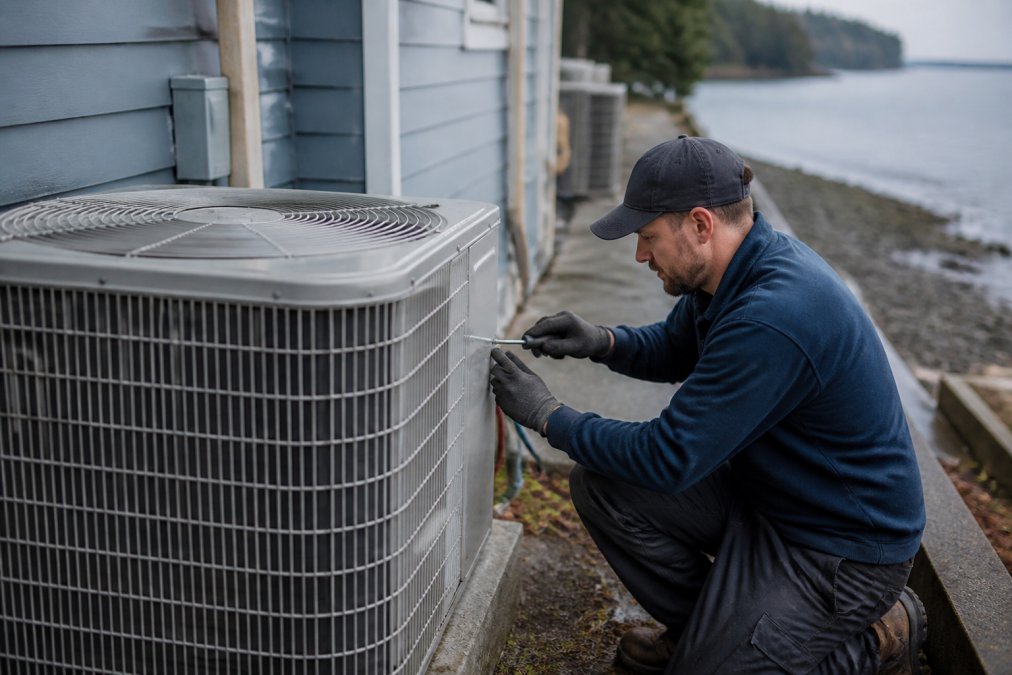
The problem starts with the condenser coil. Salt spray deposits minerals on aluminum fins. Moisture gets trapped underneath, breaking down the protective oxide layer. Once that happens, corrosion accelerates quickly.

Refrigerant lines face similar threats. Copper tubing exposed to salt air develops microscopic cracks and pinholes. A pinhole leak causes gradual refrigerant loss, forcing the compressor to work harder and wear out faster.
Electrical connections oxidize in coastal environments. Corrosion at wire terminals increases resistance, causing the system to draw more current and eventually fail.
Standard maintenance doesn’t address these coastal-specific threats. A typical tune-up cleans the coil with water and mild detergent, missing salt residue embedded deeper in the fins.
Protective coatings applied after thorough cleaning slow corrosion dramatically. Products like SaltShield Coastal Coating create a barrier against salt spray and moisture while maintaining heat transfer efficiency. For coastal homeowners, this targeted protection prevents compressor failure later, a new compressor costs significantly more than annual maintenance with protective measures.
Cost-Benefit Analysis: Does a Maintenance Plan Actually Save Money?
The math on coastal HVAC maintenance depends on what you’re comparing. If you’re deciding between a maintenance plan and doing nothing, the plan almost always wins.
Many coastal homeowners pay for annual or bi-annual maintenance through service contracts. This provides routine inspection and filter replacement, though specialized corrosion protection may cost extra.
A compressor replacement costs $1,500-$3,000 (energy.gov). A refrigerant leak repair typically runs $300-$800. Even one failure exceeds several years of maintenance payments.
Here’s where coastal maintenance differs from inland maintenance: a well-maintained system might run 12-15 years inland, but only 5-7 years on the coast without protective measures. With annual maintenance including protective coatings, you extend lifespan to 10-12 years, an extra 3-5 years from the same equipment.
Over that extended lifespan, maintenance costs are modest compared to replacement costs avoided. At $250 annually, that’s $2,500-$3,750 over 10-15 years versus $4,000-$5,000 for premature replacement.
The break-even point typically occurs within 2-3 years for coastal homeowners. After that, every year of extended equipment life essentially prevents replacement costs.
A corroded, inefficient system also consumes more electricity. A well-maintained system with clean coils and proper refrigerant charge runs 10-15% more efficiently. For a home spending $1,500 annually on heating and cooling, that’s $150-$225 in potential savings per year.
For most coastal homeowners, the financial case for maintenance is solid.
Best Dehumidifier for Coastal Home Humidity and HVAC Health
Humidity accelerates corrosion and reduces HVAC efficiency. Managing humidity protects your entire mechanical system.
Coastal humidity often exceeds 70% during fall and winter (noaa.gov). Standard air conditioning removes moisture during cooling season only. During heating season or mild months, humidity climbs unchecked, creating the perfect environment for corrosion.
A whole-home dehumidifier addresses this systematically. Unlike portable units, ducted dehumidifiers integrate with your HVAC system to manage humidity throughout the entire home. The Aprilaire E-series whole-home dehumidifier, available in 70-95 pint-per-day capacities, runs independently from your air conditioner.
Investment ranges from $2,000-$3,000 including professional installation. For coastal homes, this is justified by corrosion prevention alone. Lower humidity inside reduces the moisture gradient driving corrosion on outdoor components and prevents mold growth inside ducts.
The Ecobee Smart Thermostat Premium ($329) includes humidity monitoring and control capabilities, allowing you to track indoor moisture levels before investing in a full dehumidifier system.
For most coastal homeowners, a whole-home dehumidifier becomes necessary if indoor humidity regularly exceeds 55-60%. It pays for itself through equipment protection and energy savings over 5-7 years.
HVAC Maintenance Checklist for Coastal Homes: What to Inspect
Coastal HVAC maintenance requires attention to components that inland systems don’t face. A standard maintenance visit might miss vulnerabilities that salt air creates.

Here’s what a comprehensive coastal maintenance checklist should include:
| Inspection Item | Frequency | Why It Matters for Coastal Systems |
|---|---|---|
| Condenser coil cleaning and corrosion assessment | Bi-annually (spring and fall) | Salt spray deposits accumulate faster; standard annual cleaning is insufficient |
| Refrigerant line inspection for pinhole leaks | Annually | Copper tubing corrodes from salt exposure; early detection prevents system failure |
| Electrical connection cleaning and tightening | Bi-annually | Oxidation increases resistance; loose connections create safety hazards |
| Protective coating reapplication | Every 2-3 years | SaltShield or equivalent coatings degrade over time and need renewal |
| Compressor vibration and noise assessment | Annually | Salt-corroded components cause unusual vibration; early detection prevents failure |
| Thermostat and humidity sensor calibration | Annually | Humidity control is critical in coastal environments |
| Ductwork inspection for moisture and mold | Annually | High humidity promotes mold growth inside ducts |
| Outdoor unit frame and casing inspection | Bi-annually | Metal frames rust; protective paint needs renewal |
Coastal maintenance should occur before and after the most corrosive seasons. For Vancouver Island and Nanaimo, that typically means spring (after winter salt spray) and fall (before winter intensifies exposure).
A technician familiar with coastal systems will prioritize these items. Working with someone who understands your environment’s specific challenges, like P3 MECHANICAL & ELECTRICAL, makes a measurable difference.
Priority Service and Emergency Repairs: Real Value or Marketing?
Maintenance plans often include priority service guarantees. You get bumped to the front of the queue if your system fails. For coastal homeowners, this has genuine value. HVAC failures in winter are emergencies. Waiting three days for a technician in January is unacceptable.
Priority service typically adds 15-25% to maintenance plan costs. If a standard plan costs $200 per year, priority service might cost $250-$260.
The value depends on your risk tolerance. If your system is older (10+ years) or has had previous failures, priority service is worth the extra cost. If your system is relatively new, you might skip it.
There’s hidden value beyond response time: maintenance customers often receive 10-15% discounts on repairs. Over your system’s lifespan, these discounts can offset the entire maintenance plan cost.
Emergency repairs in coastal areas often involve corrosion-related failures requiring specialized knowledge. Choosing a service provider that prioritizes coastal systems is more valuable than just faster response time.
When to Skip a Maintenance Plan and What to Do Instead
Maintenance plans aren’t universally necessary. Some homeowners are better served by selective repairs and preventative measures they manage themselves.
Skip a maintenance plan if:
- Your system is less than 3 years old with no history of problems
- You’re planning to move within 5 years
- Your system is already 15+ years old and failing
- You’re comfortable managing humidity and corrosion protection independently
- You have cash reserves for unexpected repairs
If you skip a maintenance plan, do this instead:
DIY Corrosion Monitoring: Inspect your outdoor unit every 3 months for visible rust, corrosion, or salt deposits. Clean quarterly with a garden hose and mild soap. This takes 30 minutes and costs nothing.
Humidity Management: Monitor indoor humidity with a basic hygrometer ($15-$30). If humidity regularly exceeds 60%, invest in a portable dehumidifier or consider a whole-home system.
Filter Changes: Replace furnace filters every 1-3 months. This costs $15-$30 per filter and takes 10 minutes.
Professional Inspections: Schedule one professional inspection annually in spring. A technician can identify issues you’d miss. This costs $150-$250 but catches problems before they become expensive.
Surge Protection: Install a surge protective device like the Intermatic AG3000 ($110) on your outdoor unit to protect against lightning strikes and electrical surges.
Protective Coating: Apply SaltShield Coastal Coating every 2-3 years. Contact P3 MECHANICAL & ELECTRICAL for pricing.
This approach costs approximately $400-$600 annually compared to $200-$300 for a maintenance plan, but gives you more control. It works best for homeowners with mechanical knowledge and time to monitor their systems.
Coastal HVAC maintenance is worth it for most homeowners on Vancouver Island and Nanaimo, but only if it’s designed specifically for coastal conditions. Generic maintenance plans developed for inland climates miss the corrosion threats that accelerate equipment failure in salt-air environments.
Whether you choose a formal maintenance plan, manage corrosion protection yourself, or combine both approaches, the key is addressing the specific challenges of coastal living. P3 MECHANICAL & ELECTRICAL specializes in protecting HVAC systems from salt-air damage, extending equipment life, and reducing utility costs through energy-efficient solutions tailored to coastal conditions. GET A QUOTE to discuss which approach makes sense for your system and situation.
Frequently Asked Questions
Q: Is HVAC maintenance really necessary for coastal homes?
A: Yes, especially in coastal environments. Salt air, humidity, and moisture accelerate corrosion of outdoor units and internal components. Without preventative maintenance, your system’s lifespan shrinks significantly, and breakdowns during peak heating or cooling season become far more likely. Annual tune-ups catch rust and refrigerant leaks early, when repairs cost less than emergency calls or full replacement.
Q: How does salt air affect the lifespan of an outdoor HVAC unit?
A: Salt air corrodes aluminum fins, copper tubing, and steel components. Condenser coils become clogged with salt residue, reducing efficiency and forcing the system to work harder. Without protective measures or regular cleaning, a coastal HVAC unit typically lasts 10-12 years instead of 15-18 years. Professional maintenance and protective coatings can slow corrosion and extend equipment life by several years.
Q: What should be included in an HVAC maintenance checklist for coastal homes?
A: Priority items include cleaning condenser coil fins, checking refrigerant levels, inspecting for rust and corrosion on outdoor units, testing thermostat calibration, replacing or cleaning filters, checking ductwork for leaks, and verifying proper airflow. Bi-annual inspections (spring and fall) are recommended for coastal systems instead of annual-only schedules. Look for salt buildup around connection points and mounting hardware.
Q: Can a dehumidifier really help protect my HVAC system in a coastal home?
A: Yes. Whole-home dehumidifiers reduce indoor humidity levels, which decreases the workload on your air conditioning system and slows mold growth inside ductwork and on coils. Lower humidity also protects furniture, flooring, and electronics. A ducted dehumidifier (like Aprilaire E-series units) integrates with your HVAC system and runs independently, providing consistent moisture control without straining your air conditioner.
This article was written using GrandRanker