
Table of Contents
- How Salt Air and Humidity Affect HVAC Lifespan
- Average HVAC Lifespan in Coastal Environments
- HVAC Salt Air Protection Coating: Your First Line of Defense
- Coastal HVAC Maintenance Checklist for Extended Service Life
- Best Dehumidifier for Coastal Home Humidity Control
- Strategic Placement and Installation for Coastal Protection
- When to Replace vs. Repair Coastal HVAC Units
- Warranty Implications for Coastal HVAC Systems
Last Updated: August 30, 2026
How Salt Air and Humidity Affect HVAC Lifespan
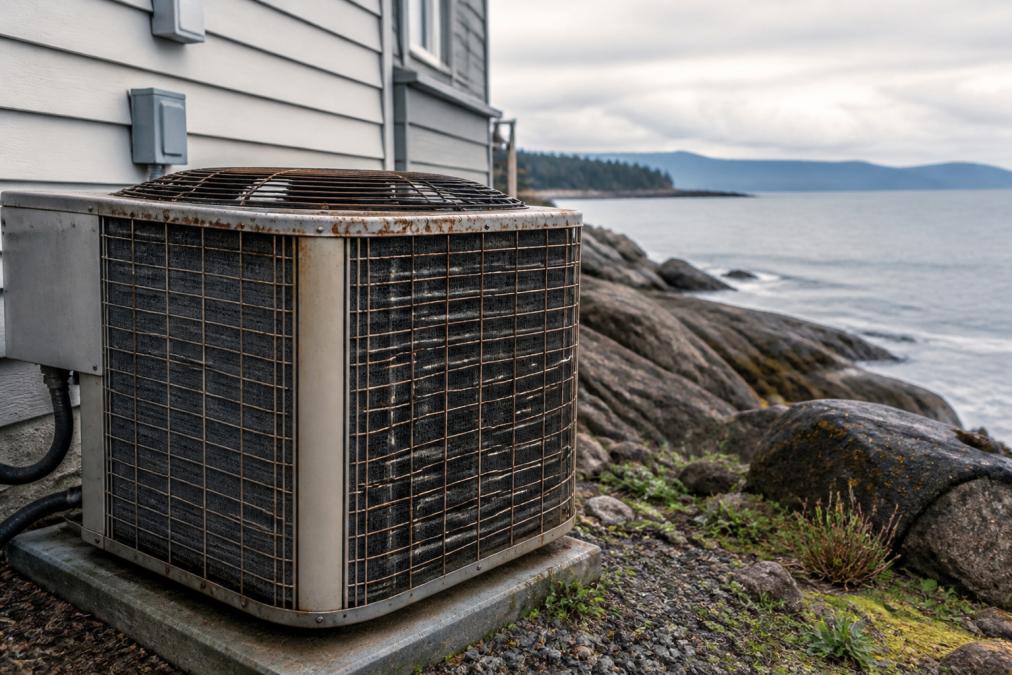
Salt air and humidity are the primary culprits behind premature HVAC failure in coastal environments. Salt particles become airborne near the ocean, travel inland, and settle on your HVAC system’s outdoor unit. These particles absorb moisture from humid air, creating a corrosive electrolyte that initiates oxidation and penetrates protective oxide layers on aluminum and copper, causing structural weakness that spreads rapidly.
Marine environments compound this damage through humidity levels exceeding 70 percent, which keeps metal surfaces wet longer and prevents natural drying that slows oxidation. Your system’s condenser coils become less efficient as salt deposits accumulate and restrict airflow, forcing the unit to work harder while delivering less cooling capacity.

Corrosion in Condenser Coils and Aluminum Fins
Condenser coils are the most vulnerable component in coastal HVAC systems. These coils typically feature aluminum fins bonded to copper tubing, chosen for thermal efficiency but poor corrosion resistance in salt air. Salt deposits create microscopic pitting that weakens aluminum structure, spreading laterally until fins separate or collapse entirely.
Aluminum corrodes faster than copper because it lacks copper’s natural protective oxide layer. Once corrosion begins, it accelerates exponentially. When fins fail, your condenser loses effective surface area for heat exchange, forcing longer cycles and shortening compressor lifespan.
Galvanic corrosion occurs when dissimilar metals sit in a salt-water environment. Copper acts as a cathode while aluminum becomes the anode, creating electrical potential that accelerates aluminum corrosion.
Oxidation of Copper Tubing and Refrigerant Lines
Copper tubing carries pressurized refrigerant through your system, and any breach compromises the entire circuit. In coastal environments, copper develops a green patina indicating active oxidation. While more stable than aluminum corrosion, it still represents progressive tubing wall weakening.
Refrigerant lines are particularly vulnerable because they’re thin-walled to minimize weight and cost. Salt spray and humidity attack from outside while pressurized refrigerant creates internal stress. Pinhole leaks develop when tubing walls thin from oxidation. Once refrigerant escapes, your system loses cooling capacity and the compressor can fail catastrophically from lack of lubrication.
Average HVAC Lifespan in Coastal Environments
A typical HVAC system installed inland lasts 15-20 years with standard maintenance (Natural Resources Canada). In coastal environments, expect replacement between 10-12 years, with some failing as early as 8 years depending on ocean proximity and maintenance practices (peer-reviewed research on coastal corrosion).
The reduction isn’t linear. A system 5 kilometres from the ocean experiences different corrosion rates than one 500 metres away. Systems within 1 kilometre of shoreline face the most aggressive conditions and typically fail fastest.
Several factors determine where your system falls within that 8-12 year window. Units on ocean-facing sides corrode faster than sheltered sides. Systems in areas with frequent salt fog events deteriorate more rapidly. Professional maintenance can extend lifespan by 2-3 years but cannot reverse fundamental salt air corrosion effects.
A failing system consumes significantly more energy as it struggles to maintain temperature. Many homeowners report 20-30 percent increases in cooling and heating costs in the final 1-2 years before failure. Early replacement often saves money compared to operating an inefficient system.
HVAC Salt Air Protection Coating: Your First Line of Defense
Protective coatings are the most effective strategy for extending HVAC lifespan in coastal environments. These coatings create a physical barrier between metal components and the corrosive atmosphere, preventing salt particles and moisture from reaching underlying material. Applied correctly, protective coating can extend your system’s lifespan by 3-5 years and reduce corrosion rates by 50-70 percent.
The most common protective coatings are epoxy-based and polyurethane-based systems. Epoxy coatings provide excellent adhesion and chemical resistance but require careful surface preparation. Polyurethane coatings offer superior flexibility and UV resistance, making them better suited to outdoor applications where temperature fluctuations cause expansion and contraction. Professional application typically costs between $800-$2,500 depending on unit size and coating type.
Coating effectiveness depends entirely on application quality and maintenance. A poorly applied coating with thin spots offers minimal protection because corrosion attacks exposed areas with greater intensity. The coating must completely seal the metal surface, leaving no pathways for salt and moisture penetration.
Types of Protective Coatings and Their Effectiveness
Epoxy coatings are durable and provide excellent adhesion to metal surfaces. They cure through chemical reaction between resin and hardener, creating a hard, impermeable barrier that resists salt spray effectively for 5-7 years before requiring reapplication. The main limitation is brittleness; epoxy coatings can crack if underlying metal expands and contracts significantly.
Polyurethane coatings offer superior flexibility and better performance in temperature-cycling environments. They accommodate metal expansion and contraction without cracking, which is critical for outdoor HVAC units experiencing daily temperature swings. Polyurethane coatings typically last 7-10 years and provide excellent UV resistance. These coatings cost slightly more than epoxy but deliver better long-term value in coastal climates.
Specialized marine-grade coatings contain additional corrosion inhibitors specifically formulated for salt air environments. These coatings incorporate zinc or aluminum particles providing cathodic protection. Marine-grade coatings offer the best protection available but cost 20-30 percent more than standard polyurethane systems. For systems within 500 metres of the ocean, the additional investment is justified.
Cost-Benefit Analysis of Protective Measures
The cost-benefit calculation for protective coatings is straightforward. A replacement HVAC system costs substantially more than coating an existing unit, and extending lifespan by 3-5 years provides significant value. If your system would normally fail in 10 years, extending it to 13-15 years through protective coating delays capital replacement cost.
A corroded HVAC system operates at reduced efficiency, consuming more energy to maintain the same temperature. Increased energy costs alone can total $300-$600 annually in a deteriorating system. Protective coating prevents this efficiency loss, keeping your system operating at design specifications. Over five years, energy savings can offset 30-50 percent of coating cost.
Applying protection to a new system provides maximum benefit by preventing corrosion from the start. Applying coating to a system already showing corrosion signs is less effective because underlying damage cannot be reversed. Coastal homeowners should consider protective coating as part of initial installation rather than as a retrofit measure.
Coastal HVAC Maintenance Checklist for Extended Service Life
Preventative maintenance is non-negotiable for coastal HVAC systems. A comprehensive maintenance program catches early corrosion, removes salt deposits, and keeps your system operating at peak efficiency.

Monthly and Seasonal Inspection Steps
Monthly visual inspections take 10-15 minutes and provide early warning of problems. Walk around your outdoor unit and look for visible corrosion, salt deposits, or debris accumulation. Check for unusual noises or vibrations when the system runs. Look for water pooling around the unit, indicating drainage problems.
After salt fog events or heavy wind, inspect the outdoor unit for salt spray accumulation. Rinse the condenser coils gently with fresh water from a hose, being careful not to apply high pressure that could damage fins. Never use a pressure washer on HVAC coils.
Seasonal maintenance should occur at least twice yearly: before cooling season and before heating season. Have a professional technician inspect and clean the entire system, check refrigerant levels, test electrical components, and verify tight connections. Clear vegetation and debris from around the outdoor unit, maintaining at least 0.5 metres of clearance on all sides to ensure proper airflow.
Professional Servicing Frequency in High-Humidity Areas
Annual professional servicing is the minimum standard for coastal HVAC systems. Many professionals recommend semi-annual servicing (spring and fall) for systems within 1 kilometre of the ocean. During professional service, technicians clean internal components, test system efficiency, check for refrigerant leaks, and apply protective treatments to exposed metal surfaces.
Professional servicing catches problems that visual inspection cannot detect. Technicians use specialized equipment to measure airflow, check refrigerant pressure, and verify electrical safety. The cost of annual servicing ($200-$400) is negligible compared to premature system failure costs.
Document all maintenance and servicing records. Many HVAC manufacturers require proof of regular maintenance to honor warranty coverage. Maintenance records help you track system performance trends and predict when replacement becomes necessary.
Best Dehumidifier for Coastal Home Humidity Control
Controlling indoor humidity reduces stress on your HVAC system and improves comfort. Coastal homes naturally have higher humidity due to ocean proximity, and HVAC systems alone often cannot reduce humidity to comfortable levels (typically 30-50 percent relative humidity). A whole-home dehumidifier works alongside your HVAC system to maintain healthy humidity levels year-round.
Whole-home dehumidifiers integrate with your existing HVAC system and dehumidify all air passing through it. These units are more effective than portable dehumidifiers because they process all air in the home. Installation typically requires integration with your ductwork, so consult with a professional before purchasing.
For coastal homes where humidity is persistent, whole-home dehumidification is the more practical long-term solution. The initial investment is higher, but energy costs and maintenance requirements are lower than maintaining multiple portable units. For coastal homes, a capacity of 30-50 litres per day is typical. Professional HVAC contractors can assess your home’s humidity levels and recommend appropriate capacity.
Strategic Placement and Installation for Coastal Protection
The location where you install your HVAC outdoor unit significantly affects its lifespan. Placement on the sheltered side of your home (away from prevailing winds and salt spray) reduces corrosion rates compared to ocean-facing placement. Install the unit on the lee side of the property, where natural landscape features provide protection from salt spray.
Height matters as well. Ground-level placement exposes the unit to salt spray and splash from rain and waves. Elevated placement on a pedestal or platform raises the unit above the worst salt spray zone while improving airflow. Many coastal installations use elevated platforms specifically designed for HVAC equipment.
Orientation affects how salt spray impacts the unit. Facing the unit away from prevailing wind directions reduces direct salt spray exposure. Ensure at least 0.5 metres of space on all sides and 1.5 metres of clearance above the unit for proper airflow. Poor airflow forces the system to work harder, consuming more energy and shortening lifespan.
When to Replace vs. Repair Coastal HVAC Units
The decision to repair or replace a failing coastal HVAC system depends on age, repair cost, and remaining useful life. As a general rule, if your system is over 10 years old in a coastal environment and requires a major repair, replacement is usually the better choice. The cost of major repair often approaches 50-70 percent of a new system’s cost, and you’re left with an aging unit that may fail again within years.
If your system is under 8 years old, repairs are usually justified because the unit still has significant remaining lifespan. If repair cost exceeds 50 percent of replacement cost, replacement is generally the better financial decision. Modern HVAC systems are 10-15 percent more efficient than systems from 10+ years ago, translating to lower energy bills.
Consider the pattern of failures as well. Multiple failures within a short period indicate that the system is reaching end-of-life. Corrosion-related failures (refrigerant leaks from pinhole leaks in tubing, condenser coil failure) are particularly common in aging coastal systems and signal that replacement is imminent.
The warranty on a new system is valuable protection against unexpected failures. Most new HVAC systems include 5-10 year warranties on parts and labour. An aging system has no warranty, and any repair is out-of-pocket.
Warranty Implications for Coastal HVAC Systems
Manufacturer warranties for HVAC systems typically cover defects in materials and workmanship for 5-10 years, depending on the manufacturer and specific product. However, many warranties explicitly exclude damage caused by corrosion, salt air exposure, or failure to maintain the system. Understanding warranty terms before purchase is essential for coastal installations.
Some manufacturers offer extended warranties that specifically cover corrosion damage, though these typically cost additional money and may include maintenance requirements. If your system includes a corrosion warranty, review the terms carefully. Many corrosion warranties require proof of regular professional maintenance and may exclude damage from extreme salt air exposure.
Installation quality affects warranty validity. If your system is installed by an uncertified contractor or in a manner that violates manufacturer specifications, warranty coverage may be voided. Always have your system installed by a certified HVAC contractor who can provide documentation of proper installation.
At P3 MECHANICAL & ELECTRICAL, our certified technicians ensure that your coastal HVAC installation meets manufacturer specifications and qualifies for full warranty coverage. We understand the unique challenges of coastal environments and recommend systems and protective measures specifically suited to salt air conditions. Our comprehensive maintenance programs help ensure your system operates reliably throughout its service life while protecting your warranty coverage.
Coastal HVAC systems face environmental challenges that inland installations never encounter. Salt air corrosion, high humidity, and temperature fluctuations all conspire to shorten equipment lifespan and increase maintenance costs. Understanding these challenges and implementing protective measures can extend your system’s life by years and reduce expensive repairs. Work with experienced professionals who understand coastal conditions, invest in protective coatings and preventative maintenance, and plan for replacement before emergency failure forces a rushed decision. P3 MECHANICAL & ELECTRICAL has helped countless coastal homeowners extend HVAC lifespan through strategic placement, protective coatings, and comprehensive maintenance programs. Get a quote today and learn how we can protect your investment in coastal comfort.
Frequently Asked Questions
How does salt air affect the lifespan of an HVAC unit?
Salt air accelerates corrosion in HVAC systems by attacking condenser coils, aluminum fins, and copper tubing. The corrosive atmosphere causes oxidation that reduces system efficiency and can lead to premature failure. Coastal units typically last 10-12 years compared to 15-20 years inland. Regular maintenance and protective coatings can slow this degradation and extend service life significantly.
What is the best way to protect an AC unit from salt air?
Apply protective coatings specifically designed for coastal environments to condenser coils and exposed metal components. Position the outdoor unit away from direct ocean exposure when possible, and install a corrosion-resistant cover during off-season months. Schedule professional maintenance twice yearly in coastal areas, spring and fall, to inspect for corrosion and clean salt residue. This combination of coatings, placement strategy, and frequent servicing provides the strongest defense against salt spray damage.
How often should HVAC systems be serviced in high-humidity coastal areas?
Coastal HVAC systems should be serviced twice per year instead of the typical once-yearly schedule. Schedule inspections in spring before cooling season and again in fall before heating season. Professional technicians will check for salt corrosion, clean condenser coils, verify refrigerant levels, and inspect copper tubing for oxidation. This increased frequency catches early corrosion damage before it becomes expensive to repair.
Does living near the ocean void HVAC manufacturer warranties?
Most manufacturer warranties do not automatically void due to coastal location, but they may exclude damage caused by salt corrosion if the unit was not installed with coastal-rated specifications or protective measures. Check your equipment’s warranty documentation carefully. Installing coastal-rated equipment, applying approved protective coatings, and maintaining professional service records helps preserve warranty coverage. Some manufacturers offer extended warranties for coastal installations if specific maintenance protocols are followed.
This article was written using GrandRanker