
How Commercial HVAC Maintenance Contract Pricing Actually Works
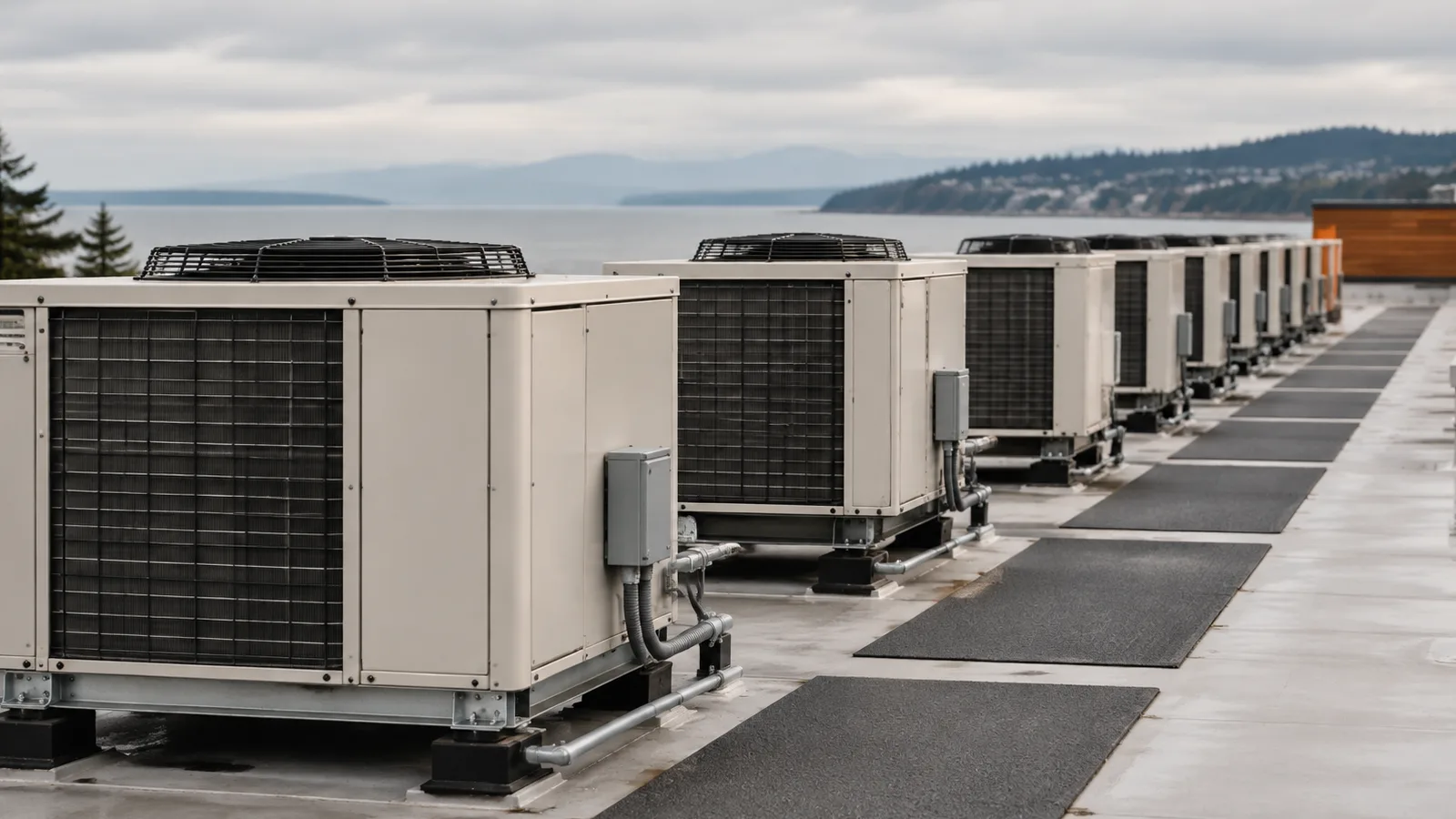
Commercial HVAC maintenance contracts are priced from a building’s equipment list — how many units, of what type and age, and how hard they are to reach — not from floor area or a published rate per square foot. This article explains what drives the number, how inspection-only and full-coverage tiers differ, which exclusions do the real damage to a cheap-looking quote, and how to compare two proposals that are not describing the same work.
Why nobody quotes this over the phone
The first thing worth knowing is why nobody serious will quote a maintenance contract over the phone. Two buildings of identical floor area can differ by a factor of several in maintenance cost: one has two straightforward rooftop units reached by a fixed ladder and a roof hatch, the other has nine units of four different vintages, a make-up air unit over a kitchen, a chiller, and a roof reached by a lift booked in advance. Floor area describes neither.
What the contract is actually priced from is the equipment list: make, model, age, location, and the labour hours each unit needs per visit. That list is built by walking the roof and the mechanical room, which is why a serious proposal arrives after a site visit and an unserious one arrives the same afternoon. If a quote lands without anyone having looked at your equipment, what you are holding is a guess that will be revised upward on the first visit.
What actually moves the number
Unit count and type dominate. Each piece of equipment is its own set of inspection points, its own filters, and its own trip up the ladder, so five small rooftop units cost more to maintain than one large one of the same total capacity. Complexity compounds it: a unit with an economizer, demand-controlled ventilation, and a building automation front end takes longer to check properly than a constant-volume unit with a thermostat, and the controls work is where the hours quietly go.
Age and condition set the second axis. Equipment that has been maintained on schedule since installation needs less attention than the same model that has been ignored for six years, and a contractor pricing the second one is pricing the failures it expects to find. Obsolete equipment costs more again — when a control board or a fan motor is no longer manufactured, it comes from a specialty supplier at a specialty price, and the older refrigerants are getting harder and more expensive to source every year as the phase-down proceeds.
Access is the factor owners consistently underestimate. A rooftop unit reached through a hatch is ordinary work; the same unit reached by a rented boom lift, or sitting behind a parapet that requires fall protection to approach, carries that cost into every single visit for the life of the contract. On this coast, add salt exposure: a unit facing the Strait needs its coils cleaned more often than an identical unit two blocks inland, and that frequency is a line in the price.
Inspection only, or coverage as well
Contracts sort roughly into two shapes, and the words used for them are not standardised, so read the scope rather than the tier name. The lighter shape is inspection and preventative maintenance: scheduled visits, filters, coil cleaning, belts, condensate, readings recorded, seasonal changeover, and a written report. Parts and repair labour are billed separately as they arise. The heavier shape adds coverage — replacement parts for normal wear items, and sometimes the labour to fit them — which converts an unpredictable repair budget into a fixed annual line.
Neither is automatically better value. Coverage is priced on the contractor’s expected repair cost plus a margin for risk, so on newer equipment in good condition you are usually paying a premium to insure against failures unlikely to happen. On a fleet of aging units the same premium is often the cheaper end of the deal. The honest test is which of the two of you is better placed to carry the risk of an unexpected compressor, and to price it.
What a scheduled visit should cover
- Filters changed, belts and bearings checked on every unit, not sampled across the fleet
- Coils cleaned and condensate drains cleared before the season loads them
- Refrigerant and electrical readings recorded and compared against the previous visit
- Controls, safeties, and interlocks exercised — including make-up air against what the hoods pull
- Economizer dampers and linkages checked, since they fail open or shut without any alarm
- A written report per site: what was done, what is being watched, and what needs quoting
Reading the agreement itself
A contract you can hold someone to names the equipment individually — make, model, serial, location — rather than referring to "the HVAC system". It names visit months rather than saying regular maintenance, because quarterly means nothing if the quarters are never scheduled. It states what is covered and what is billed, in that order of detail, and it says what happens to a repair that exceeds a threshold: does it proceed, or does it stop for your approval, and at what number.
The exclusions are where a cheap contract earns its price back. Compressors, heat exchangers, coils, and refrigerant are the four things most commonly carved out of coverage, and they are also the four most expensive things that fail. Refrigerant is worth reading twice: some agreements cover the first leak repair in a term and bill every one after it. Also look for what voids coverage — work done by another contractor, or an equipment modification made without notice, is a standard clause and a standard surprise.
Two clauses matter more than their length suggests. The first is documentation: the agreement should require a written report after each visit, because a maintenance program that produces no record is not tracking system health, it is just performing tasks. The second is the term — how long it runs, how it renews, whether the price escalates on renewal and by what mechanism, and what notice cancels it. A contract that renews automatically at an unspecified price is not a price you have agreed to.
Comparing two proposals honestly
To compare two proposals, normalise them onto the same equipment list before you look at either number. Proposals routinely differ in what they cover — one includes the make-up air unit, the other silently leaves it out — and the cheaper one is frequently cheaper because it is smaller. Once the scopes match, ask each contractor the same three questions: what is excluded, what is the visit frequency per unit type, and can I see a sample of the report I would receive.
The last question separates contractors faster than the price does. A sample report shows whether readings are recorded and trended or whether the visit produces a checkmark, and trending is the entire mechanism by which preventative maintenance is supposed to work: a compressor drawing more amps than it did in March is a diagnosis, while a ticked box is only an attendance record. Planned work is cheaper than reactive work mostly because someone was watching the numbers change.
Frequently asked questions
What actually drives the price of a commercial HVAC maintenance contract?
The equipment, not the building: a contract is priced per site from the equipment list — unit count, type, age, and how the roof is reached — rather than from floor area or a published rate card. Unit count and type set the baseline, age and condition adjust it, controls complexity adds labour hours, and roof access can raise the cost of every visit for the life of the agreement. That is also why we quote per building instead of publishing a rate: the number comes out of a walkthrough, and the estimate is free.
What should be written into the agreement itself?
Each unit identified by make, model, serial, and location; the visit months named rather than described as regular; the tasks performed per visit; what parts and labour are covered and what is billed; the approval threshold above which a repair stops for your sign-off; a required written report after every visit; and the term, renewal, price-escalation, and cancellation clauses. Vague scope is the source of nearly every dispute.
How often should the visits actually happen?
It depends on the equipment and what the building does — a kitchen exhaust and make-up air setup needs attention far more often than an office rooftop unit, and coastal salt exposure shortens coil cleaning intervals. Our own maintenance plans are annual, semi-annual, or a schedule built around your equipment, and whichever shape a site ends up on, the schedule belongs in the contract by month rather than as a number of visits per year.
Is a full-coverage contract worth the extra over inspection only?
It depends on who is better placed to carry the risk. Coverage is priced on the contractor’s expected repair cost plus a risk margin, so on newer, well-maintained equipment you are usually paying a premium against failures that are unlikely. On an aging fleet, where a compressor or a heat exchanger is a live possibility, the same premium is often the cheaper side of the deal. Check whether those two components are excluded before deciding.
What gets excluded from these contracts most often?
Compressors, heat exchangers, coils, and refrigerant — the four most expensive things that fail. Some agreements cover the first refrigerant leak repair per term and bill every one after it. Coverage is also commonly voided by work another contractor performs on the equipment, or by a modification made without notifying the provider. Read the exclusions before the monthly figure; that is where a cheap contract makes its money back.
How do I compare two quotes that look nothing alike?
Normalise the scope first: list the equipment both proposals actually cover, because the cheaper quote is often cheaper for having quietly left a unit out. Then ask both contractors what is excluded, how often each type of unit is visited, and to show you a sample of the service report you would receive. The report tells you whether readings are trended over time or whether the visit produces a checkmark.
Where we offer this
Ready to get it fixed?
Call now, or send us the details online and we'll follow up.