
Commercial HVAC Repair in Nanaimo: What Fails and Why
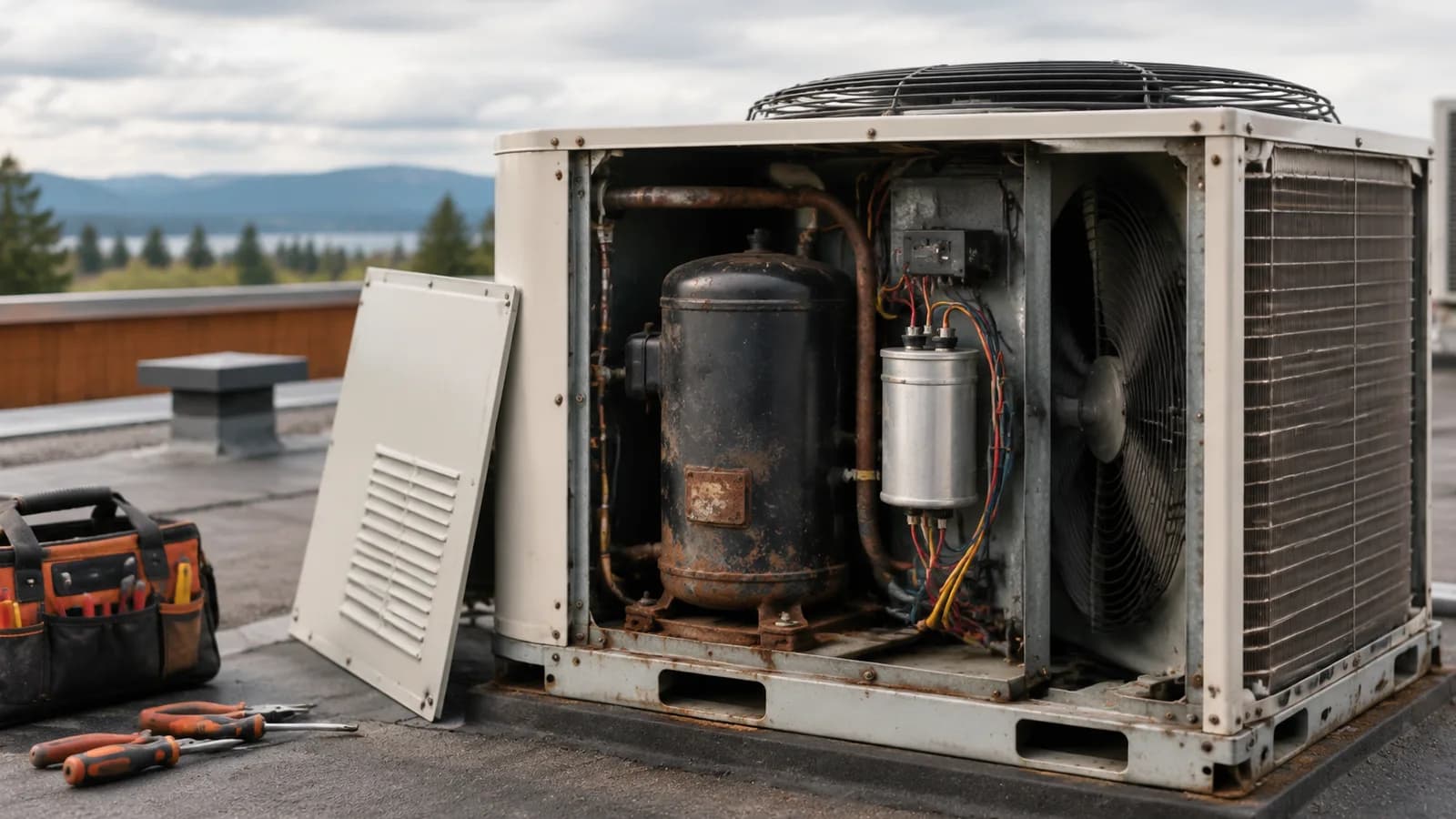
Commercial HVAC equipment in Nanaimo fails differently than it does inland: salt-laden air off the Strait of Georgia corrodes condenser coils, cabinet fasteners, and electrical connections years before a compressor wears out, and wind-driven rain on a flat roof finishes the job. This article covers the failures that actually show up on Island commercial roofs, how a rooftop unit is diagnosed rather than guessed at, and how the repair-or-replace decision is made on equipment that is halfway through its life.
Why commercial equipment fails faster here
Commercial equipment ages differently on this coast, and it ages from the outside in. Salt carried in off the Strait settles on condenser coils and aluminium fins, and the galvanic corrosion that follows eats the fin-to-tube bond, the cabinet fasteners, and the terminals inside the electrical section. The result is a unit that loses capacity gradually — rejecting heat worse every season, running longer to hold the same setpoint, drawing more current for less cooling — well before any single part fails outright.
The second factor is water. A flat commercial roof in a Nanaimo winter takes wind-driven rain from the side, not just from above, and it finds the seams of an outdoor cabinet, the service panel gasket someone left proud, and the conduit entry nobody re-sealed after the last repair. Standing water in a base pan accelerates everything already described. That is why failures here cluster in the shoulder seasons: equipment that has been quietly degrading all winter gets asked to work hard on the first genuinely warm week, and does not.
Reading the symptoms before the shutdown
Most commercial failures announce themselves for weeks before they stop the building. The symptoms below are worth reporting when you notice them rather than when the space becomes unusable, because nearly all of them are cheaper to fix at the stage they first appear:
What to report early
- The system runs but never reaches setpoint on the warmest or coldest days — usually lost capacity from fouled coils, low refrigerant charge, or airflow restriction rather than an undersized unit
- One zone is comfortable and another is not — commonly a failed zone damper, a stuck actuator, or a control fault rather than a whole-system problem
- Short cycling: the unit starts and stops repeatedly, which loads the compressor harder than continuous running and points at a safety cut-out tripping
- Energy consumption up with no change in occupancy or weather, which is what fouled coils and a slipping charge look like on a bill
- Noise with a pattern — grinding suggests bearings, squealing suggests belts, rattling suggests something loose that is wearing something else
- Water where it should not be: a blocked condensate drain will find a ceiling tile long before it finds a maintenance schedule
What a real diagnosis looks like
A commercial rooftop unit does not usually need to be guessed at. It records why it stopped: control boards hold fault codes, and the safety chain — high discharge pressure, low suction pressure, thermal overload, a tripped limit — narrows the cause before a panel comes off. Reading that first, then confirming it with pressures, superheat and subcooling, and electrical readings taken under load, is the difference between a repair and a sequence of replaced parts that each fail to fix it.
This is also where a maintenance history earns its cost. A compressor drawing more current than it did at the last recorded visit is a diagnosis; the same reading with nothing to compare it against is just a number. Buildings that keep readings from every visit get shorter diagnostic time on the day something breaks, which is a large part of why planned maintenance is cheaper than reactive repair in a way that has nothing to do with the visits themselves.
Repair or replace
On this coast, corrosion usually decides repair-or-replace before run hours do. Once the cabinet, the coil, and the electrical connections are all going at once, each repair buys less time than the one before it, and the money is being spent on a unit whose remaining life is set by the parts nobody is replacing. A compressor fitted into a corroded cabinet is a good component in a failing assembly.
Parts availability is the second input. When a control board or a specific motor is no longer manufactured, lead times stretch and prices leave the range anyone would call a repair — and the refrigerant question runs alongside it, since older refrigerants get scarcer and dearer each year as the phase-down proceeds, which quietly raises the cost of every future leak on an aging system. The third input is what the failure costs the business: a restaurant dining room or a grocery display case has a different tolerance for a two-day parts wait than a warehouse does.
None of that is a formula, so it should be presented as a choice rather than a recommendation. In practice diagnosis is quoted before the repair, and when a unit is near the end of its life we price the repair and the replacement side by side so the owner can choose. An owner with both numbers, the equipment age, and an honest read on the corrosion can make that decision better than a contractor can make it for them.
The rules a commercial repair touches
Commercial work touches more rules than residential work does, and a repair can quietly breach one. Anyone handling refrigerant needs a valid refrigerant-handling certification under federal and provincial regulation, and recovery has to be logged — that is a requirement on the work, whoever performs it. Gas-fired equipment carries permit obligations that fall on the contractor rather than the building owner, and the electrical side of a replacement carries its own, on whoever holds the electrical licence for that part of the job.
Interlocks are the quieter risk. A kitchen exhaust hood, its make-up air unit, and the suppression system over the line are one interconnected assembly: replace or re-control the make-up air unit without re-proving the interlock and the building can pass a casual look while failing its next fire inspection. Fire dampers in ducts crossing a fire separation belong in the same category. Where mechanical, electrical, and fire protection meet is exactly where a repair scope split between three subcontractors leaves a gap.
After the repair
A repair is a good moment to fix the thing that caused it. Coil cleaning on a schedule matched to the site’s salt exposure, condensate drains cleared before the season loads them, and electrical connections torqued and recorded will prevent a meaningful share of what this article describes. Our maintenance plans are annual, semi-annual, or a schedule built around your equipment, and on a coastal site the equipment is usually what sets that interval rather than the calendar.
If you are looking after a building rather than a home, the commercial page covers how that work is scoped, scheduled, and reported, and the maintenance page covers what a planned visit includes. When something has already failed, have the unit’s make, model, and serial number ready, along with any fault code on the control board, what the space is doing without it, and how the roof is reached. That last one determines what shows up in the truck.
Frequently asked questions
What are the signs my commercial HVAC system needs repair?
The system running but never reaching setpoint on the hottest or coldest days, one zone comfortable while another is not, short cycling, energy use climbing with no change in occupancy, a new noise with a pattern to it, or water appearing near the unit or below it. On coastal sites, add visible corrosion on condenser fins and cabinet fasteners — that one predicts failures rather than reporting them.
Why does equipment in Nanaimo fail sooner than the same unit inland?
Salt-laden air off the Strait corrodes condenser coils, aluminium fins, cabinet fasteners, and electrical terminals, so units lose heat-rejection capacity and develop electrical faults years before the compressor reaches the end of its rated life. Wind-driven rain on a flat roof pushes water into cabinet seams and service panels from the side. Both are why coil cleaning intervals here are shorter than a manufacturer’s generic schedule assumes.
How often should a commercial system be serviced?
It depends on the equipment and the building — kitchen exhaust and make-up air need attention far more often than an office rooftop unit, and salt exposure shortens coil cleaning intervals on any coastal site. Our own plans are annual, semi-annual, or a schedule built around your equipment. Whatever the cadence, the readings from each visit should be recorded so the next one has something to compare against.
Our rooftop unit is about 20 years old — repair it or replace it?
On this coast corrosion usually decides it before run hours do: once the cabinet, coils, and connections are all deteriorating, each repair buys less time than the last. Parts availability and refrigerant supply on older systems push the same way. The useful step is to get the repair and the replacement priced side by side, along with an honest assessment of the corrosion, and decide from both numbers.
What should I have ready when I call about a failure?
The unit’s make, model, and serial number, any fault code showing on the control board, what the space is doing without it, and how the roof or mechanical room is reached — hatch, fixed ladder, or a lift that has to be booked. Access is the detail most often left out of the first call, and it is the one that decides whether the right equipment arrives with the technician.
Where we offer this
Ready to get it fixed?
Call now, or send us the details online and we'll follow up.