
Furnaces and Boilers in Nanaimo: Service, Repair, or Replace Before Winter
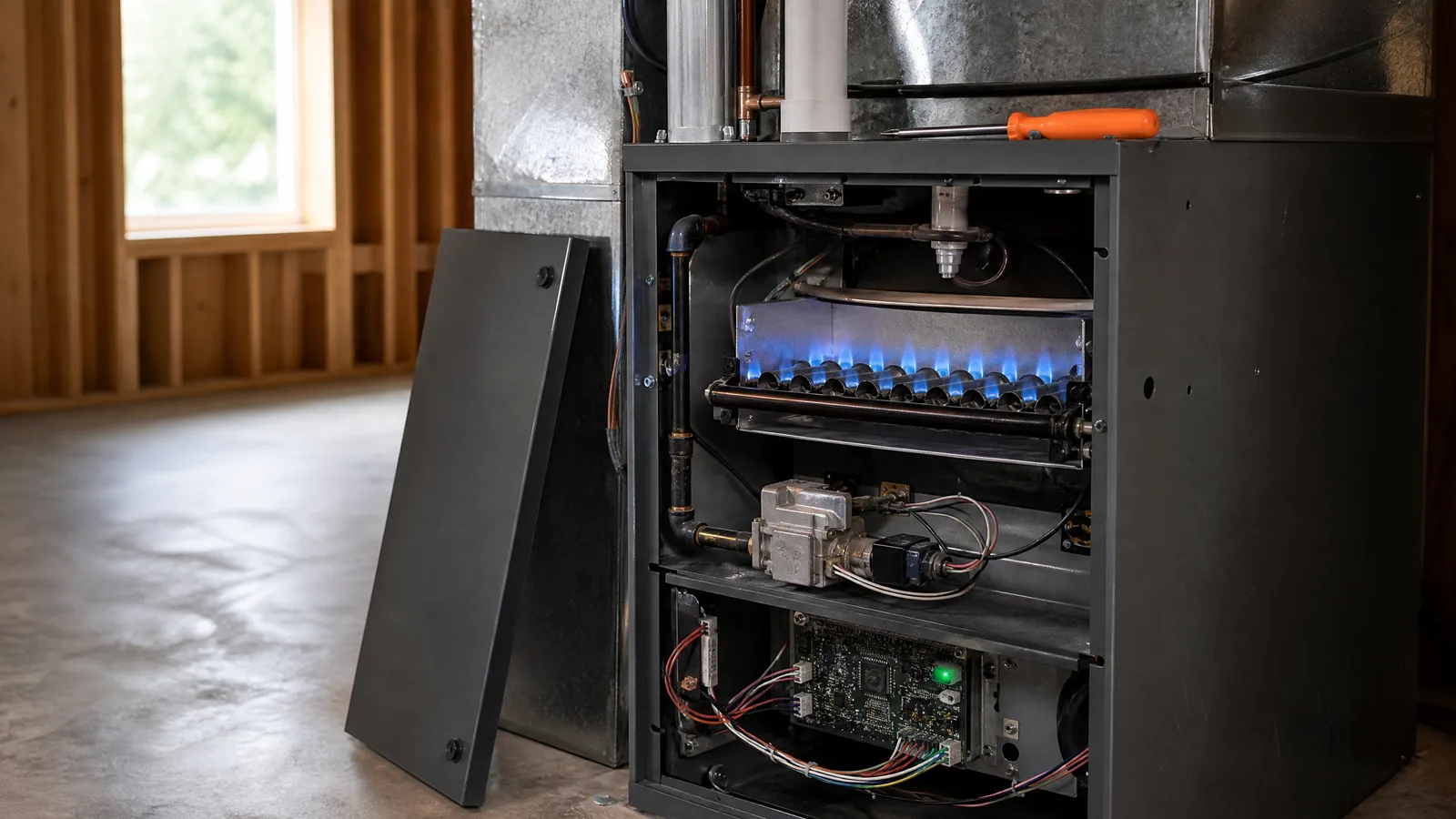
A furnace and a boiler fail in different places: a furnace at ignition and airflow, a boiler on the water side, in pressure, pumps, and scale. Most of what goes wrong in a Nanaimo winter announces itself weeks earlier as a longer run, a new noise, or a gauge that keeps drifting. This guide sorts those signs into service, repair, and replacement, and ends with what to check yourself before the first cold week.
How a furnace and a boiler fail differently here
A forced-air furnace, gas or electric, heats air and pushes it through ducts, so almost everything that goes wrong with it is either a problem making heat or a problem moving air. On a gas furnace the usual suspects are the igniter, the flame sensor, the pressure switch, the gas valve, and the limit switch that shuts the burners off when the heat exchanger runs too hot. On an electric furnace the heat comes from banks of elements staged on by sequencers, so the usual fault is one bank that has stopped coming on, and the house is warm but never warm enough.
A boiler heats water and sends it around radiators or in-floor loops, and its troubles live on the water side. It loses pressure between top-ups. Scale builds on the heat exchanger and the boiler starts to kettle, a rumbling like a stovetop kettle coming to the boil. A circulator pump or a zone valve sticks and one part of the house goes cold while another overheats. The first sign of trouble on a boiler is usually a gauge, a noise, or a damp patch rather than a cold room.
The Island adds its own pattern. Our heating season is long and mild rather than short and deep: a system here runs from October into April at low output, which means many more start-up cycles over a winter, and start-up is where igniters, flame sensors, and pumps wear. The damp finds its way in as well: condensing furnaces and boilers produce condensate that has to drain, and a drain line that has grown algae over a wet summer is a common reason a high-efficiency unit refuses to light in October. None of this is dramatic. It is the kind of wear a yearly look catches and a skipped year does not.
Signs it needs a service, not a repair
- Run times are getting longer. The thermostat still gets there, but the system works noticeably longer to do it than last winter, and the bill says so.
- The filter is grey well before its change date, or the registers are dusty. Airflow is being lost somewhere, and a furnace that cannot move air overheats and shuts itself down.
- The furnace lights a second or two late, or with a soft whump. A dirty flame sensor or an igniter near the end of its life will do this for weeks before it fails outright.
- The boiler needs topping up a few times a season. A sealed hydronic system should hold its pressure; a slow fall means a small leak or a tired expansion tank, and either is a service item until it becomes a daily one.
- Radiators warm at the bottom and cool at the top, or one loop slower than the rest. Air in the system, which a bleed and a pressure check fix, or a pump or valve starting to stick.
- An oil furnace that smokes at start-up, or a sooty smell in the basement. The nozzle, oil filter, and ignition electrodes are consumables, and an untuned burner burns more fuel for the same heat.
Signs it needs a repair now
Some signs do not wait for a tune-up. A furnace that is silent with the thermostat calling, once the furnace switch, the thermostat, and the breaker have been checked, has a fault inside the cabinet. A furnace that fires, runs a minute or two, and shuts down again, over and over, with a clean filter and open registers, is overheating or losing its flame. A blower that runs but delivers cool air means the burners are not lighting or the elements are not being switched on. On an electric furnace, a breaker that trips again after one reset is saying that something in the furnace is drawing more current than it should; resetting it a third time is not a plan.
On a boiler the repair-now list is shorter and wetter: pressure that drops daily rather than seasonally, water on the floor under the unit or at a pump, kettling that has become loud and constant, a lockout on a fault code more than once in a week, one zone that stays cold with the pump running. Each is a part that has failed rather than one that is wearing, and a boiler run through a winter with a leak or a heavy scale load ends the winter needing a heat exchanger.
An oil furnace that shuts down and will not restart has a reset button on the burner. Press it once only: repeated resets pump unburned oil into the combustion chamber, which is a fire hazard. If one press does not bring it back, it is a service call.
Two signs are not repair calls at all, at least not first. If you smell gas near the furnace or the boiler, leave the house without switching anything on or off, and call the FortisBC gas emergency line, printed on your gas bill, or 911 from outside. If a carbon monoxide alarm sounds, do the same. Neither is a job for a heating contractor until the gas utility or the fire department has cleared the house.
When replacement is the honest answer
Gas furnaces are built for something like fifteen to twenty years of winters, and past that point the failures stop arriving one at a time. One fault ends the conversation on its own: a cracked heat exchanger, the wall that keeps combustion gases out of the air the blower moves through the house. It is not repaired, it is replaced, and that means a new furnace; if a technician tells you yours is cracked, ask to see it, because a crack can be shown. Short of that it is arithmetic. A capacitor, a flame sensor, or an igniter is worth fitting to almost any furnace; a blower motor or a control board on a unit near the end of that band starts to favour the new one, because the parts that have not failed yet are the same age as the ones that have.
A boiler's life is harder to put a number on, and we do not. A cast-iron boiler can run for decades on a system kept clean and at pressure, and die young on one topped up with fresh water every week, because every top-up brings in oxygen and minerals the exchanger pays for. The signs that replacement is the honest answer are the ones a service does not fix: kettling that comes back soon after a flush, a heat exchanger that is weeping, repeat leaks from the same casting, and parts nobody makes any more. If the pumps, zone valves, and expansion tank are due at the same time, replacing them around an old boiler is money spent twice.
With an oil furnace the tank often decides. Insurers ask about its age and construction and set their own limits past which they will not renew, and a buried tank discovered during a sale can turn into soil testing at the owner's cost. At that point replacing the tank is one option and switching the heat source is the other.
The replacement does not have to be more of the same. A house with ductwork can go to a ducted heat pump, which uses the same ducts, cools in summer, and is what the CleanBC Better Homes and BC Hydro rebate programs are built around, where a new gas furnace is not. A house heated by radiators or in-floor loops can keep them and run them from an air-to-water heat pump. What a household qualifies for depends on the program terms in force and the equipment chosen, never on a single published amount. A furnace or a boiler is still the right answer for plenty of Island homes; the honest version of the conversation is a written quote with the repair and the replacement side by side, after somebody has measured the heat loss of the house rather than copied the output off the old label.
What to check yourself before the first cold week
- Run the heat on a mild day in October, before you need it. Set the thermostat a few degrees above room temperature and let the system go through a full cycle; anything it is going to do wrong, it will do now, with time to book a visit before the first cold week.
- Find the furnace switch and make sure it is on. It looks like an ordinary light switch, on or beside the unit or at the top of the basement stairs, and it gets bumped off over a summer.
- Put the thermostat in heat and change its batteries if it takes them. A thermostat left in cool after a warm September is the cheapest no-heat call there is.
- Change the filter, open every register, and clear the returns. A grey filter is the single most common reason a furnace short cycles, and a bookcase over a return grille starves the whole system, not just that room.
- Walk outside to the vent terminations. A high-efficiency furnace or boiler vents through white plastic pipes on an outside wall; clear leaves, a wasp nest, or a woodpile away from them, and remember them when the snow comes.
- Look at the condensate line on a high-efficiency unit. If the small hose or pipe that drains it is kinked, blocked, or green inside, the unit will shut down when it fills.
- On a boiler, read the pressure gauge cold against the range on the data plate or in the manual, then bleed the radiators and check the gauge again. If it needs topping up again within the week, book a visit rather than making it a habit.
- Press the test button on every carbon monoxide alarm and replace the batteries. If you have a fuel-burning furnace, boiler, or fireplace and no CO alarm, that is the first thing to buy this fall.
- On an oil furnace, check the tank level and look at the filter and lines for weeping before the first fill. Running a tank to the bottom stirs up sludge the filter and the nozzle then have to deal with.
What a professional heating check covers
What a homeowner can see is the outside of the box. A professional heating check opens it, and the point of the visit is to find the part that is wearing before it fails on the coldest night. On a gas furnace that means the heat exchanger inspected, the flame sensor cleaned, the igniter and pressure switch tested, a combustion test, the blower and its capacitor checked, the connections inside the cabinet tightened, and a full heating cycle run. On an electric furnace the elements and sequencers are tested bank by bank, which is how the one that has quietly dropped out gets found.
A boiler check is a different list for the same reason it fails differently: system pressure and the expansion tank, the circulator pumps and zone valves, the relief valve, the condensate drain on a condensing unit, combustion and venting, and the heat exchanger for scale and for weeping. An oil furnace gets its nozzle, oil filter, and ignition electrodes as a matter of course, then a burner clean and adjustment, a combustion efficiency test, and a look at the tank with its vent and fill lines.
The visit ends with a written summary of what was found and what, if anything, needs attention next, so a repair that is coming can be booked around your calendar rather than the weather's. Gas work on a furnace or boiler is done under P3's Technical Safety BC gas contractor licence LGA0207015. Plans are annual, semi-annual, or a schedule built around your equipment, with the heating check in the fall; a heat pump doing both seasons earns a spring visit as well. What the visit costs depends on the type of system and how much equipment is being checked, and it is confirmed when you book, not after. The one thing a check cannot do is make the equipment younger: if what it finds is a heat exchanger or a long list, the honest answer is the one above.
Frequently asked questions
How often should a furnace or boiler be serviced on Vancouver Island?
Once a year, before the heating season, for a gas furnace, an oil furnace, or a boiler, and most manufacturers tie their warranty to it. A heat pump that heats in winter and cools in summer earns a second visit in spring. The fall check is the one not to skip: a fault found in October is booked around your calendar, and one found in December around everybody else's.
My furnace runs but the house never gets warm. Is that a service, a repair, or time to replace it?
Start with the filter and the registers; a furnace starved of air overheats, shuts the burners off on the limit switch, and runs the blower on cool air, which feels exactly like this. If those are fine, on a gas furnace it is usually the burners not staying lit, and on an electric furnace one bank of elements not coming on; both are repairs. It becomes a replacement question when the furnace is near the end of its life and the failed part is a large one, or when the real cause is a furnace that was never the right size for the house.
Is the kettling noise from my boiler dangerous?
Not immediately, but it is not a sound to live with. Kettling is scale on the heat exchanger trapping water and letting it flash to steam, so the exchanger runs hotter than it should at those spots. A flush often quiets it. If it comes back soon afterwards, it is usually the early warning of an exchanger on its way out, and the better money is a replacement quote in the fall rather than a failure in January.
What should I do if I smell gas near my furnace or boiler?
Leave the house. Do not switch anything on or off on the way out, lights included, and do not start a car in an attached garage. From outside, call the FortisBC gas emergency line, which is printed on your gas bill, or 911. The utility or the fire department clears the house; a heating contractor comes after that to find and fix the leak, never before.
Should I replace my old furnace with a heat pump instead of another furnace?
For a house with ductwork, it is worth pricing. A ducted heat pump uses the same ducts, cools in summer, and is the equipment the CleanBC Better Homes and BC Hydro rebate programs are built around; a new gas furnace is not. What you qualify for depends on the program terms in force and the equipment installed, not on a published figure, and we fill out the CleanBC and BC Hydro paperwork as part of the job. A furnace is still the right choice for some homes; what matters is that both are in the same written quote.
Ready to get it fixed?
Call now, or send us the details online and we'll follow up.