
How to Reduce Your Utility Bills in Nanaimo
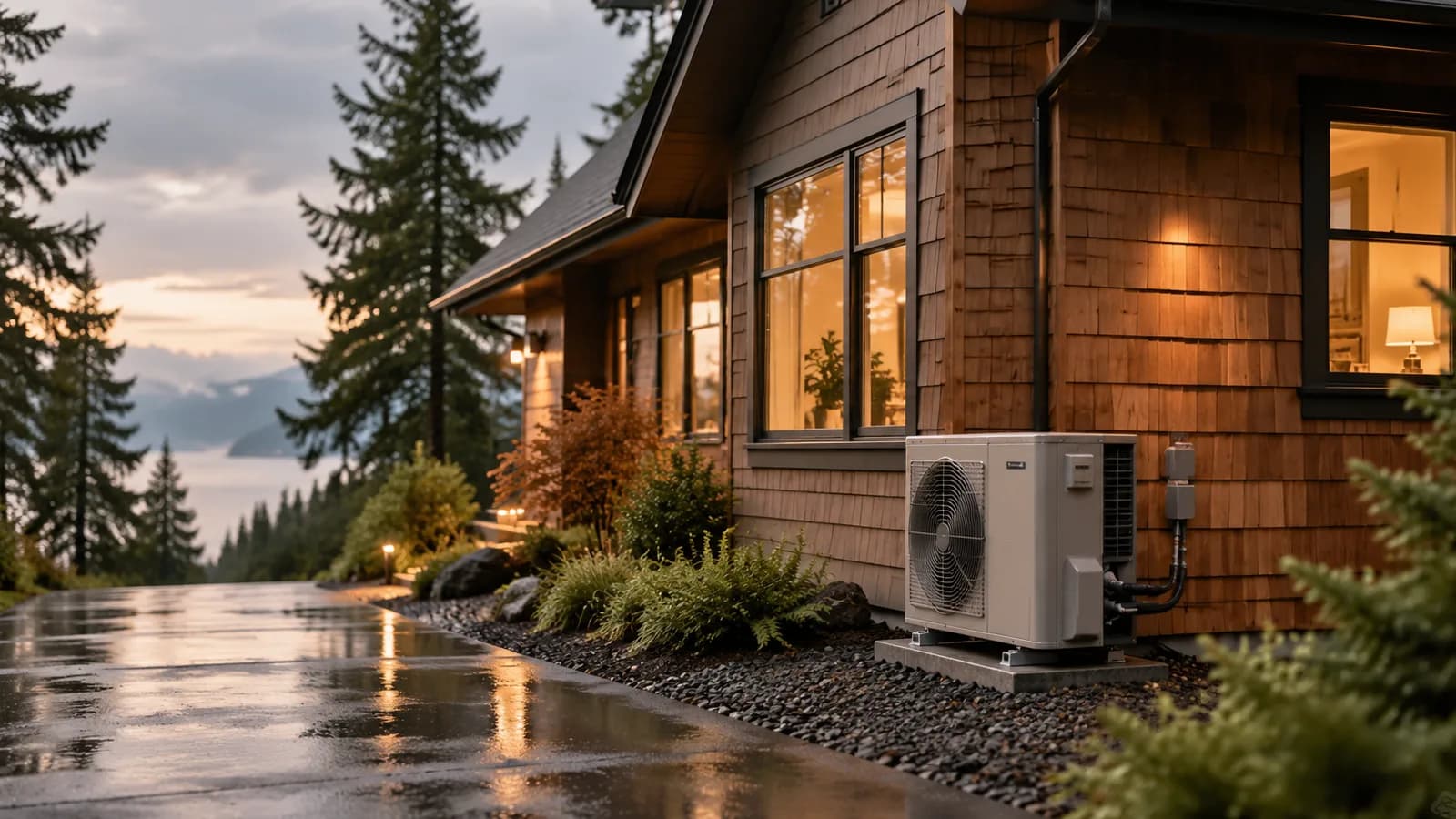
A Nanaimo household pays three separate utilities: electricity from BC Hydro, water, sewer, and curbside collection from the City of Nanaimo or the regional district, and natural gas from FortisBC if the house is connected to it. Only the consumption side of each bill responds to anything you do, and on Vancouver Island most of that consumption is space heating and hot water. This guide works through the changes that actually move the number, from a filter swap to a heat pump.
Where the money on the bill actually goes
Three different organisations bill a Nanaimo household for what most people think of as one thing. BC Hydro charges for electricity by the kilowatt-hour. The City of Nanaimo or the regional district charges for water, sewer, and curbside collection, depending on where the property sits. FortisBC charges for natural gas if the house is connected. Each of those bills splits the same way: a fixed service charge that is not negotiable, and a consumption charge that is entirely within your control.
On the coast, that consumption side is dominated by two things — keeping the house warm and heating water. Island winters are mild but long, with the heating season running from roughly October into April rather than concentrating into a few deep-cold weeks, so a house that heats inefficiently pays for it across six or seven months a year. Lighting, appliances, and standby draw are worth tidying up, but they are rounding errors next to a baseboard system or an aging oil furnace running through a wet island winter.
Read your own bill before changing anything
Most statements include a twelve-month comparison of your own consumption, and that graph is more useful than any national average, because it describes your house rather than an average one. Photograph the last three bills, note the kilowatt-hours and the cubic metres, and you have a baseline to measure changes against instead of a feeling that things seem better.
The same graph is the cheapest leak detector in the house. Water consumption that climbs well above the same month last year, with nothing changed in the household, almost always means a running toilet, a dripping outdoor tap, or a supply line weeping somewhere out of sight. Because sewer charges are generally calculated from metered water volume, a hidden leak is billed twice over.
While the bills are out, check the administrative details too: whether your provider offers anything for electronic billing or for paying on time, and whether the account is on the right plan for the property. It is one phone call and it changes nothing about how you live in the house.
Cheap fixes that show up on the next bill
- Change the furnace or heat pump filter on schedule — a clogged filter makes the blower work harder to deliver the same heat.
- Replace the flapper or fill valve in a toilet that keeps running. It is a cheap part and a twenty-minute job, and a toilet running unnoticed is the single most expensive small fault in a house.
- Fit aerators on the faucets and a low-flow head on the shower. Both cut hot water use, which lowers the water bill and the energy bill at the same time.
- Turn the hot water tank down from its maximum to a safe setting, and insulate the first stretch of hot pipe leaving the tank.
- Seal the obvious air leaks: weatherstripping on exterior doors, gaskets behind outlets on exterior walls, and the gap where the rim joist meets the foundation.
- Put entertainment gear and chargers on a switched power bar so they are not drawing power around the clock.
- Run full loads in the dishwasher and washing machine, and skip the heated dry cycle.
Heating is the lever that moves the number
If the house runs on electric baseboards or an oil furnace, everything above is worth doing and none of it will change the shape of the bill the way replacing the heat source will. A heat pump moves heat rather than generating it, which is why it delivers several units of heat for every unit of electricity it draws, and why it has become the default replacement here once a furnace or a baseboard system reaches the end of its life. Cold-climate models handle Island winters without difficulty — we simply do not get the temperatures that give heat pumps trouble.
That upgrade is not cheap, which is what the rebate programs exist for. CleanBC Better Homes and BC Hydro both run rebates on qualifying heat pump installations, and combined CleanBC Better Homes and BC Hydro rebates can cover a meaningful share of a heat pump installation. Worth knowing before you book anything: some of those rebates expect a home energy evaluation before the work starts rather than after it, so the order of operations matters as much as the choice of equipment.
Two other things tend to ride along with the decision. An older electrical panel sometimes needs a circuit added before an outdoor heat pump unit can be wired in — panel work is a separate licensed trade in British Columbia and not something we take on — and a house coming off oil has a tank to deal with. Both are far cheaper to establish before the work is booked than to discover halfway through an installation.
Water, sewer, and curbside collection
Water and sewer are metered, and because sewer volume is generally derived from water volume, every litre saved counts twice. The fixtures listed above handle most of it. What they do not handle is a slow leak under a slab or behind a wall, and that is worth chasing the moment the consumption graph says something changed rather than waiting to see whether it settles.
Curbside collection works differently: it is usually a flat charge, so conservation does not reduce it — but bin size sometimes does. If your municipality offers a smaller cart, and composting and recycling have left the garbage bin half empty every week, downsizing is a single phone call that lowers a fixed charge. That is a rare thing on a utility bill and worth taking when it is offered.
When it is worth paying someone
Filters, flappers, aerators, and weatherstripping are homeowner work. A home energy evaluation, a heat pump sizing calculation, and leak detection behind finished walls are not — not because they are hard to attempt, but because getting them wrong costs more than the visit. Sizing is the one that matters most: an oversized heat pump short-cycles and an undersized one leans on backup heat, and both undo the savings the equipment was bought for. A panel that needs a new circuit belongs on the same list, with one difference: it is electrical work, licensed separately in this province, and not work we do.
If the cost of the work is what is holding the decision, the rebates are the first place to look rather than the last, and we file the CleanBC and BC Hydro applications as part of the installation rather than leaving them with you; ask at the estimate which programs your job actually qualifies for, because the terms are revised between cycles.
Frequently asked questions
What's actually on my Nanaimo utility bill?
Usually three bills from three different organisations: electricity from BC Hydro, water, sewer, and curbside collection from the City of Nanaimo or the regional district, and natural gas from FortisBC if your house is on gas. Each one splits into a fixed service charge you cannot change and a consumption charge you can. Sewer is generally billed off metered water volume, so water you save is counted twice.
Will a heat pump actually lower my hydro bill?
In a house heated by electric baseboards, yes, and by a wide margin rather than a marginal one — a heat pump moves heat instead of generating it, so it delivers several units of heat for every unit of electricity it draws. How much you save depends on how the house is heated now, how well it holds heat, and whether the system is sized correctly. Replacing a recent, efficient gas furnace is a different calculation and does not always pay off on running costs alone.
Are there rebates for a heat pump in Nanaimo?
Yes. CleanBC Better Homes and BC Hydro both run rebate programs on qualifying heat pump installations, and combined CleanBC Better Homes and BC Hydro rebates can cover a meaningful share of a heat pump installation. Note that some of those rebates expect a home energy evaluation before the work starts rather than after it, so the sequence matters. As for the forms, we file the CleanBC and BC Hydro applications as part of the installation rather than leaving them with you.
How do I find a water leak I can't see?
Start with your own consumption history — a jump against the same month last year, with nothing changed in the household, is the usual first sign. Then close every fixture and watch the water meter: if it is still moving, water is going somewhere. A running toilet is the most common cause and the cheapest to fix; a supply line weeping inside a wall or under a slab needs leak detection equipment.
Is a smart thermostat worth installing?
On a ducted furnace or ducted heat pump, usually yes. Setting the house back overnight and while it is empty is the one saving that costs nothing to maintain, and a programmable thermostat does it without anyone having to remember. It is far less useful on electric baseboards with individual thermostats, and a ductless heat pump normally has scheduling built into its own controller already.
When should I call someone instead of doing this myself?
When the job involves gas, refrigerant, or a leak you cannot see — and anything at the electrical panel, which is a separately licensed trade and not one we work in. Filters, flappers, aerators, and weatherstripping are homeowner work, and doing those first means a paid visit gets spent on what actually needs equipment: sizing a heat pump, measuring airflow, or locating a leak behind a finished wall.
Where we offer this
Ready to get it fixed?
Call now, or send us the details online and we'll follow up.