
Why Mechanical Systems Fail on Vancouver Island — and What Prevents It
Most heating, cooling, and plumbing failures in Vancouver Island buildings trace back to seven ordinary causes: salt-air corrosion, trapped moisture, dirt and scale, worn bearings and capacitors, storm-season power problems, sizing or installation mistakes, and skipped maintenance. Nearly all of them give warning before the system stops, and nearly all are cheaper to catch than to repair.
What actually breaks in Island buildings
Equipment rarely fails for exotic reasons. A component gives out when something wears it, corrodes it, blocks it, overheats it, or asks it to do a job it was never sized for. On this coast the first two do most of the damage, and the rest are usually consequences of the last one.
The brand on the cabinet matters far less than people expect. the difference between a system that reaches its expected service life and one that quits years early is mostly down to three things: the environment the equipment sits in, the quality of the original installation, and whether anyone looked at it between breakdowns. Two identical heat pumps installed in the same week on the same street can end up years apart in condition for those reasons alone.
The seven causes behind most failures
- Salt-air corrosion on outdoor units, coils, fasteners, and cabinets.
- Moisture with nowhere to go: blocked condensate drains, damp crawlspaces, bathrooms and dryers vented into the building.
- Dirt and scale — loaded filters, fouled coils, and mineral build-up in tanks, tankless units, and boiler loops.
- Worn moving parts: fan and pump bearings, blower motors, and run capacitors.
- Storm season: outages, surges, and equipment restarting into a fault.
- Sizing and installation mistakes that were built into the system on day one.
- Deferred maintenance, which turns every item above into an emergency call-out eventually.
Salt air, and what it does to metal
Air within a few kilometres of the water carries chloride, and it settles on everything outdoors. Where it stays wet, it pits aluminum fins, corrodes steel cabinets and screws, and eventually seizes fasteners so badly that a routine service becomes a replacement. A heat pump or condenser facing open water in an exposed spot ages visibly faster than the same unit two streets inland behind a hedge.
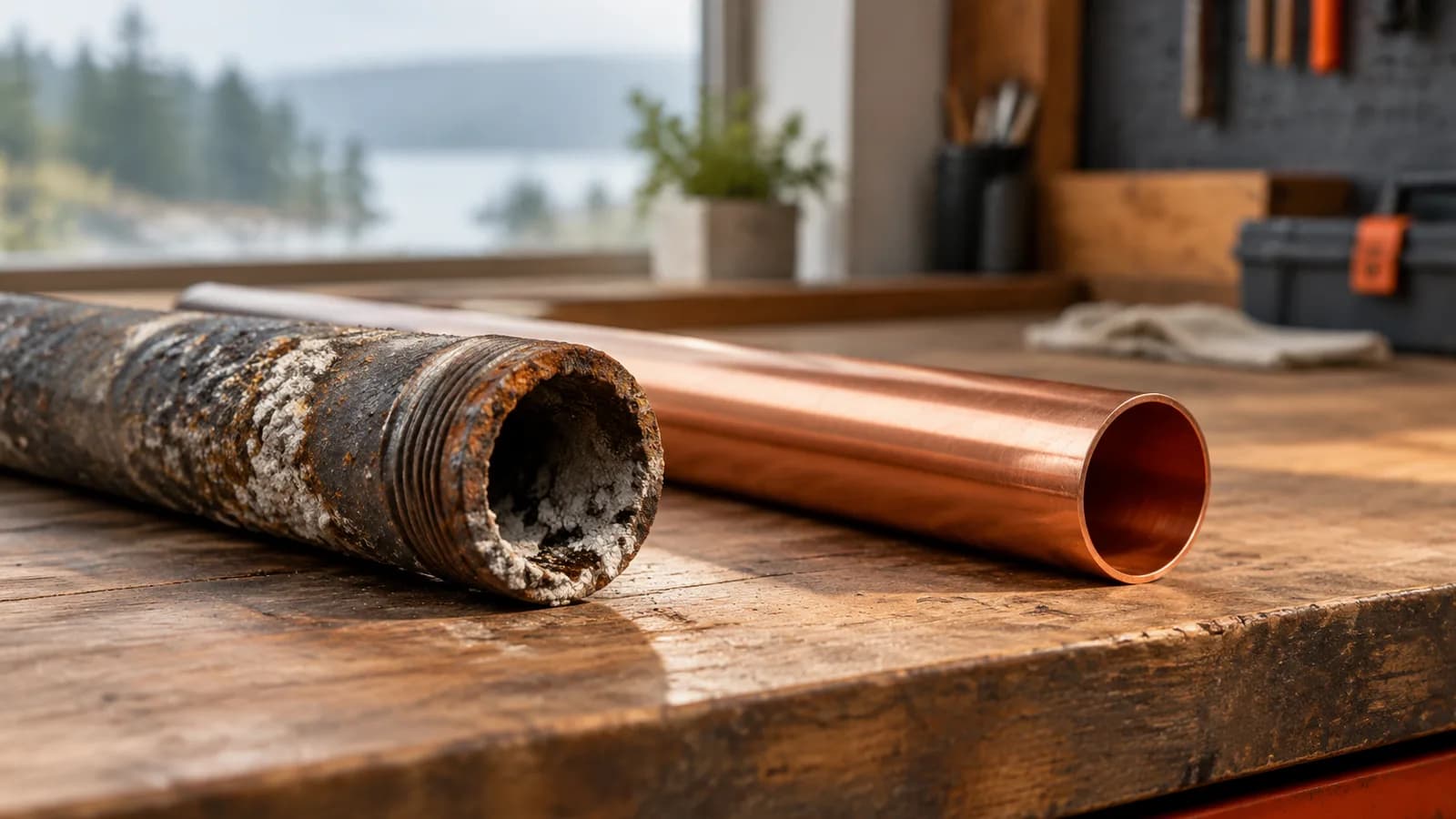
The countermeasures are unglamorous and effective: coated coils, corrosion-resistant hardware, mounting that keeps the unit clear of wet ground and out of direct spray, and a plain freshwater rinse of the outdoor coil during routine service. Corrosion also explains one of the most common plumbing failures in older Island houses — copper landing directly on galvanized steel without a dielectric fitting, where the joint corrodes from the inside long before either metal would have failed alone.
Water where it should not be
A cooling coil and a condensing furnace both produce water by design, and everything downstream depends on the drain staying clear. A condensate line closed off by algae backs up into the pan, then into the equipment, then into the ceiling below. It is among the cheapest failures to prevent and the most expensive to find late, and our long damp shoulder seasons make it routine here.
The bigger version of the same problem is the building itself. Crawlspaces that stay damp most of the year corrode ducting and pipe hangers from the outside in, and bath fans or dryers vented into a crawlspace or attic instead of outdoors dump litres of water a day into the structure. A properly ducted bath fan or a heat recovery ventilator is not a comfort upgrade in that situation — it is what stops the corrosion.
Dirt, scale, and starved airflow
Most heating and cooling equipment fails from starvation rather than abuse. A loaded filter or a fouled indoor coil restricts airflow, so a furnace heat exchanger runs hotter than it was designed to and the blower motor works harder for less result. The same restriction on the cooling side drives pressures out of range and ends, months later, in a compressor failure that gets blamed on the compressor. most filters need checking every one to three months, sooner in a house with pets or ongoing renovation dust, and it is the single cheapest thing a building owner can do without calling anyone.
On the water side, hard water leaves scale in tanks, tankless heat exchangers, and boiler loops. Scale is a good insulator: the burner stays on longer for the same hot water, the metal behind the deposit runs hot, and the appliance loses efficiency and life together. Descaling on a schedule is routine work; replacing a tankless unit that scaled shut is not.
Parts that were always going to wear out
Fans, pumps, and motors run on bearings, and bearings have a finite life. They almost always announce themselves first — a new hum, a rattle at start-up, a housing running hot — weeks or months before anything seizes. Run capacitors are the other common consumable: a weak one makes a compressor or motor draw hard every time it starts, and it is a small part to replace before it takes an expensive one with it.
The materials science behind all this is worth exactly one paragraph. Metal that is heated and cooled thousands of times, or shaken by a component slightly out of balance, accumulates microscopic damage and eventually gives way — at whatever spot concentrates the stress, usually a sharp corner, a corrosion pit, or an over-tightened joint. That is the practical reason a small vibration or a weeping fitting is treated as a repair rather than a cosmetic annoyance: it marks where the eventual break will start.
Storm season and the electrical side
Island winters do their damage through wind rather than deep cold. Outages and the voltage disturbances around them are hard on control boards, variable-speed drives, and anything else with electronics — which now includes most heat pumps and every modern furnace. Equipment that restarts into a brownout, or into a fault it already had, can lose a board that would have survived a clean shutdown.
The electrical side of the house contributes as well. A heat pump added to a panel with nothing left to give, or a large appliance sharing a circuit it should not, produces nuisance trips and voltage drops that quietly shorten motor life. Surge protection at the panel and correctly sized dedicated circuits are inexpensive next to a replacement control board and a week without heat. That work is a separate licensed trade in British Columbia and not one we take on — it is on this list because the damage lands on mechanical equipment, not because it is our department.
Failures installed on the first day
Some systems were never going to reach their expected life, and no maintenance schedule saves them. Equipment sized by matching the old unit instead of by a heat-loss calculation short-cycles for years, and short-cycling multiplies wear on every component that starts and stops. Ductwork that is undersized or leaking into a crawlspace makes a correctly sized system behave like an oversized one.
Assembly matters as much as selection. Pipe runs left unsupported, drains sloped the wrong way, a refrigerant circuit not evacuated before charging, a flue with the wrong clearance — none of these fail at commissioning. They fail years later, and the fix is corrective work on the installation itself rather than another service visit.
What a real service visit catches
A service visit earns its money through what it finds: airflow and filter condition, condensate drain flow, coil and cabinet corrosion, refrigerant charge and operating pressures, electrical connections loosened by vibration, capacitor values drifting out of tolerance, bearing noise, combustion and flue checks on gas equipment, and the condition of drains and shut-offs on the plumbing side.
Every one of those is a minor item during a scheduled visit and a major one during a call-out on a January evening — an emergency call-out generally costs several times what the same work costs when it is planned. The honest goal is not a system that never fails. It is a system that fails on a Tuesday afternoon, when a part can be ordered and the building stays warm in the meantime.
Frequently asked questions
What actually causes most heating and plumbing failures in a house?
Corrosion, moisture, restricted airflow, and worn moving parts account for most of it, and on the coast the first two run ahead of the rest. Salt air attacks outdoor units and fasteners, damp crawlspaces corrode ducting and pipe hangers from the outside, clogged filters and fouled coils make equipment run hotter than it was designed to, and fan and pump bearings simply wear out. Undersized or badly installed equipment is the other large category, and that one is built in on the first day.
Do systems usually fail suddenly, or is there warning first?
Most give warning. A bearing hums or rattles for weeks before it seizes, a weak capacitor makes a compressor struggle on start-up, a corroding fitting weeps before it bursts, and a restricted system heats or cools noticeably worse before it stops. Sudden failures do happen — frozen or brittle old pipe, and control boards hit by a surge, are the common ones — but the usual pattern is a small symptom ignored long enough to become a call-out.
Is monitoring equipment worth it, or is a yearly inspection enough?
For a house, a proper annual inspection catches nearly everything that matters: airflow, drain flow, corrosion, refrigerant charge, loose electrical connections, and bearing noise. Continuous monitoring earns its keep in commercial buildings, where a rooftop unit or a pump running out of spec is expensive to miss and nobody is standing next to it. In both cases the point is the same — find the problem while it is still a part, not a failure.
Can maintenance stop a system from failing altogether?
It cannot prevent every failure, and any company promising that is selling something. What it does is shift when failures happen and what they cost: an emergency call-out generally costs several times what the same work costs when it is planned. Regular service catches corrosion, drain blockages, drifting capacitors, and bearing wear while they are still small parts, so the realistic goal is a planned repair on a weekday rather than a dead system on the coldest night of the year.
Where we offer this
Ready to get it fixed?
Call now, or send us the details online and we'll follow up.