
Commercial Plumbing Maintenance Best Practices for Vancouver Island
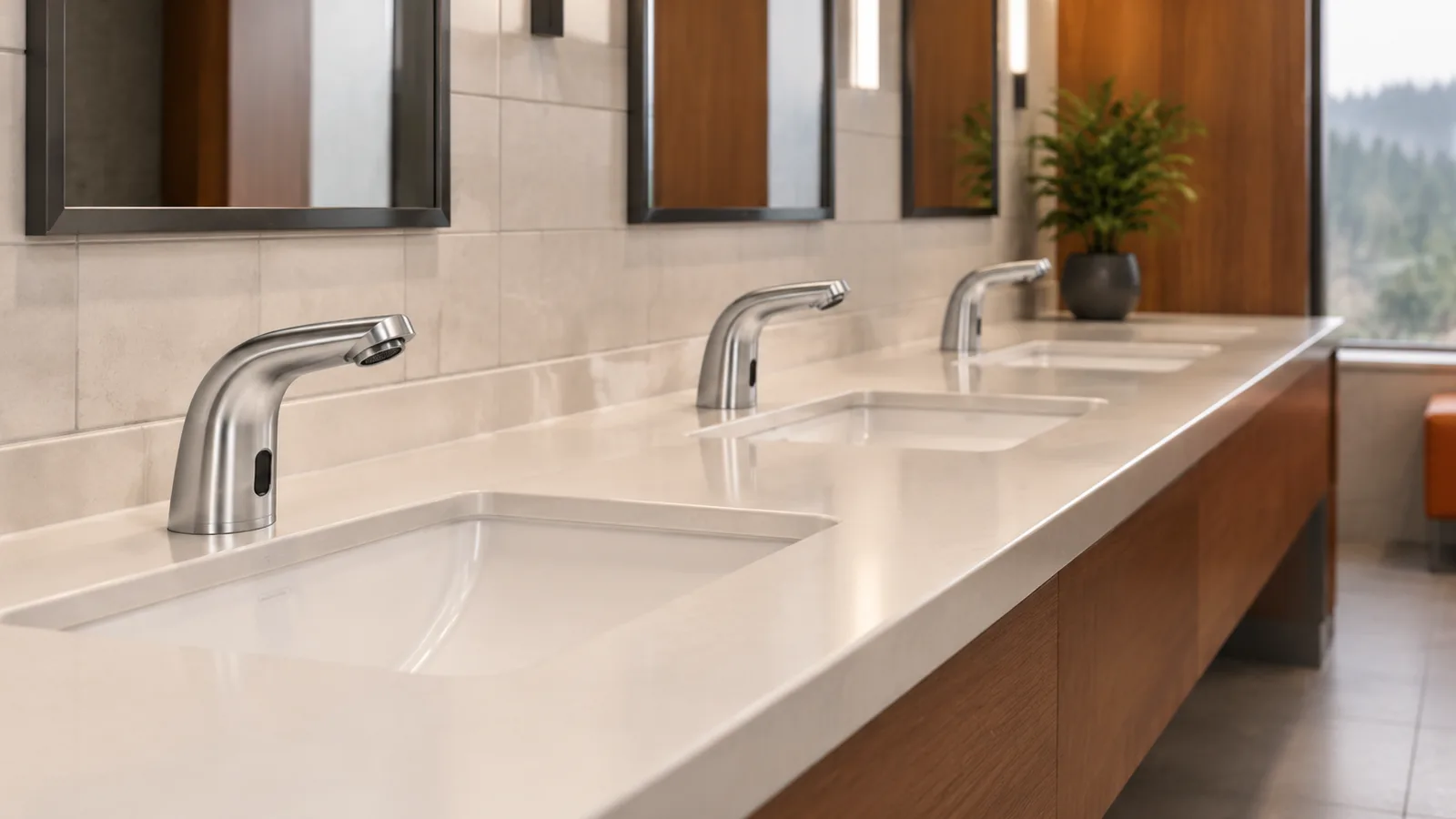
Commercial plumbing maintenance is a scheduled program of inspection, cleaning, and testing across a building's supply, drainage, and hot water systems, run on a monthly, quarterly, and annual cycle instead of waiting for something to back up. On Vancouver Island the recurring problems are predictable — grease in kitchen lines, salt-accelerated corrosion, sediment in water heaters, and backflow assemblies that have to be tested on the municipality’s schedule — which is exactly what makes them plannable.
Why deferring plumbing maintenance is the expensive option
Plumbing is the building system facility managers think about least, mostly because it works quietly and its failures stay invisible right up until they are not. The bill for a burst supply line or a backed-up main is rarely the plumbing bill. It is the closed floor, the ruined stock, the tenant who could not trade for two days, and the conversation with an insurer about how long the leak had been running before anyone noticed.
That asymmetry is the entire argument for a maintenance program. The work itself is unglamorous — clearing a drain, flushing sediment out of a water heater, operating a valve that has not been turned in a year — and its defining feature is that it happens on a schedule set around the building’s quiet hours instead of one dictated by whatever fails first.
The part that is not optional
Some of this is not discretionary. Most BC municipalities run a cross-connection control program that requires backflow prevention assemblies to be tested on a set cycle by a certified tester, with the results filed with the city. Food service premises are subject to grease interceptor requirements. Temperature and pressure relief valves on water heaters exist for a safety reason that only becomes visible when one fails. Check your own municipality’s bylaw rather than assuming, because the cycle and the paperwork are not identical across Nanaimo, the regional district, and the smaller island municipalities.
The other half of compliance is records. A maintenance log showing what was inspected, when, and what was found is what turns "we maintain the building" into something an inspector, an insurer, or a prospective buyer can verify. Keep the written reports. They are the cheapest part of the program and the part most often thrown out.
The monthly and quarterly walkthrough
- Monthly: look under sinks and around fixtures for stains, damp, or soft drywall
- Monthly: run every fixture and check flow, drainage speed, and anything that drips, hisses, or hammers
- Quarterly: inspect exposed pipe for corrosion, green or white deposits, and weeping joints
- Quarterly: check water heaters for sediment noise, temperature setting, and leaks at the fittings
- Quarterly: operate the main and isolation shut-off valves so they cannot seize open
- Quarterly: check grease interceptors for buildup and confirm the pump-out record is current
- Every visit: write it down — date, finding, action taken, and who did the work
What the annual inspection adds
Once a year the building gets the work that cannot be done from a clipboard. A camera survey of the main drain and the sewer connection shows what no amount of rodding will: root intrusion at a joint, a bellied section holding water, grease steadily narrowing the line, or a crack that explains why one branch backs up every winter. Water heaters get flushed and their anodes checked, TPR valves get tested, and pressure gets measured at the far end of the building rather than at the meter, because that is where a failing pressure reducing valve shows itself.
The output should be a written report: system condition, what was found, what needs repair now, and what can wait a year with a note to watch it. That document becomes the baseline the following year is compared against, which is what turns a slowly developing problem into a visible trend instead of a surprise.
Where commercial buildings actually fail
Grease is the first one. Kitchen lines in restaurants, cafeterias, and staff kitchens load up far faster than any residential drain, and in a mixed-use building on a shared stack, one tenant’s kitchen can shut down the unit above it. Interceptors need pumping on a schedule set by volume rather than by the calendar, and the line downstream needs cleaning before it narrows, not after it blocks.
The rest are quieter. Sediment settles in water heaters and costs efficiency long before it costs a tank. Water pressure sitting too high wears out fixtures, valves, and appliances across the entire building, and the pressure reducing valve that is supposed to prevent that is itself a wearing part. Salt air and damp crawlspaces accelerate corrosion on exposed pipe and hangers, which is why a quarterly pipe inspection is worth more on an island building than the same inspection would be inland.
A seasonal schedule for Vancouver Island properties
- Spring — check for freeze damage on exposed and exterior lines, arrange backflow testing, and inspect exterior pipe and hose bibs for corrosion
- Summer — monitor pressure through peak occupancy, check irrigation and outdoor fixtures, and book drain cleaning while the building is quiet
- Fall — insulate exposed pipe in crawlspaces and parkades, flush sediment from water heaters, and operate every shut-off valve before winter
- Winter — watch for freeze damage through cold snaps, keep shut-off locations posted and accessible, and deal with slow drains before the holiday load reaches them
What a maintenance contract should spell out
A maintenance contract is worth having when it is specific. It should name the equipment and fixtures covered, the visit frequency, what is included in each visit, how work outside that scope is priced, and what documentation you get afterwards. If emergency response matters for your building — a restaurant, a clinic, a manufacturing floor — get the commitment in writing rather than accepting a general assurance, and ask what happens when the failure lands outside a normal working day.
For our own commercial work: plans are annual, semi-annual, or a schedule built around your equipment, and a contract is priced per site from the fixture and equipment list rather than off a rate card. When something fails between visits, we respond to service requests within 24 hours — a reply within a day, which is a different commitment from an arrival time, and the distinction is worth insisting on with anyone you ask. Every contract starts with a walkthrough and an equipment inventory, because a scope written without seeing the mechanical room is a guess dressed up as a quote. The walkthrough and the estimate that comes out of it are free.
The mistakes that cost the most
Three mistakes account for most of the damage. Deferring maintenance because the quarter is tight, which converts a scheduled cost into an unscheduled one at a worse moment. Maintaining inconsistently — six months of inspections, then a year of nothing — which produces a record with holes in it and problems that develop precisely in the gaps. And choosing a contractor on price alone, which on plumbing work usually means paying twice for the same job.
Frequently asked questions
What should a commercial plumbing maintenance checklist cover?
Monthly visual checks of fixtures and visible pipe; quarterly inspection of corrosion, water heaters, shut-off valves, and grease interceptors; and an annual assessment that includes a camera survey of the main line, TPR valve testing, a water heater flush, and backflow testing where the municipality requires it. Every item should end up in a written log, because the log is what proves the program exists.
How often does a commercial building's plumbing need inspecting?
Monthly for the visible things, quarterly for the mechanical ones, and annually for the full assessment. The first two are walkthrough checks building staff can carry out with a clipboard; the annual one needs a contractor and equipment. Buildings with commercial kitchens, older infrastructure, or heavy occupancy usually move drain cleaning and interceptor service onto a shorter cycle, because those are driven by volume rather than by the calendar.
Why pay for a sewer camera inspection if nothing is blocked?
Because a camera is the only way to see the condition of a line nobody can reach. It separates root intrusion at a joint from grease narrowing the pipe from a cracked or bellied section — three different repairs at three very different costs — and it turns a backup that gets rodded out every spring into a problem with a known cause and a permanent fix.
How often does a grease trap need pumping?
By volume, not by date. A busy restaurant kitchen may need it monthly while a small staff kitchen goes far longer, and the practical test is the buildup level at the quarterly check: if the interceptor is filling faster than the schedule, the schedule is wrong. Local bylaws set a minimum, and food premises are what an inspector looks at first.
How much does a commercial plumbing maintenance contract cost?
It depends on the size of the building, the age of the infrastructure, and how much of it is kitchen, so a contract is priced per site from the fixture and equipment list rather than off a rate card. Our plans are annual, semi-annual, or a schedule built around your equipment. We scope and price it after a walkthrough rather than over the phone, because a quote written without seeing the mechanical room is a guess — and the walkthrough that produces the estimate costs nothing.
What should be in a maintenance contract before I sign it?
The equipment and fixtures covered, the visit frequency, the documentation you receive after each visit, how repairs outside the scheduled scope are priced, and what happens when something fails between visits. On that last point ours is specific: we respond to service requests within 24 hours. Vague contracts are the ones that turn into arguments about whether something was included.
Ready to get it fixed?
Call now, or send us the details online and we'll follow up.