
Poly-B Plumbing in Nanaimo Homes: How to Tell, and What to Do
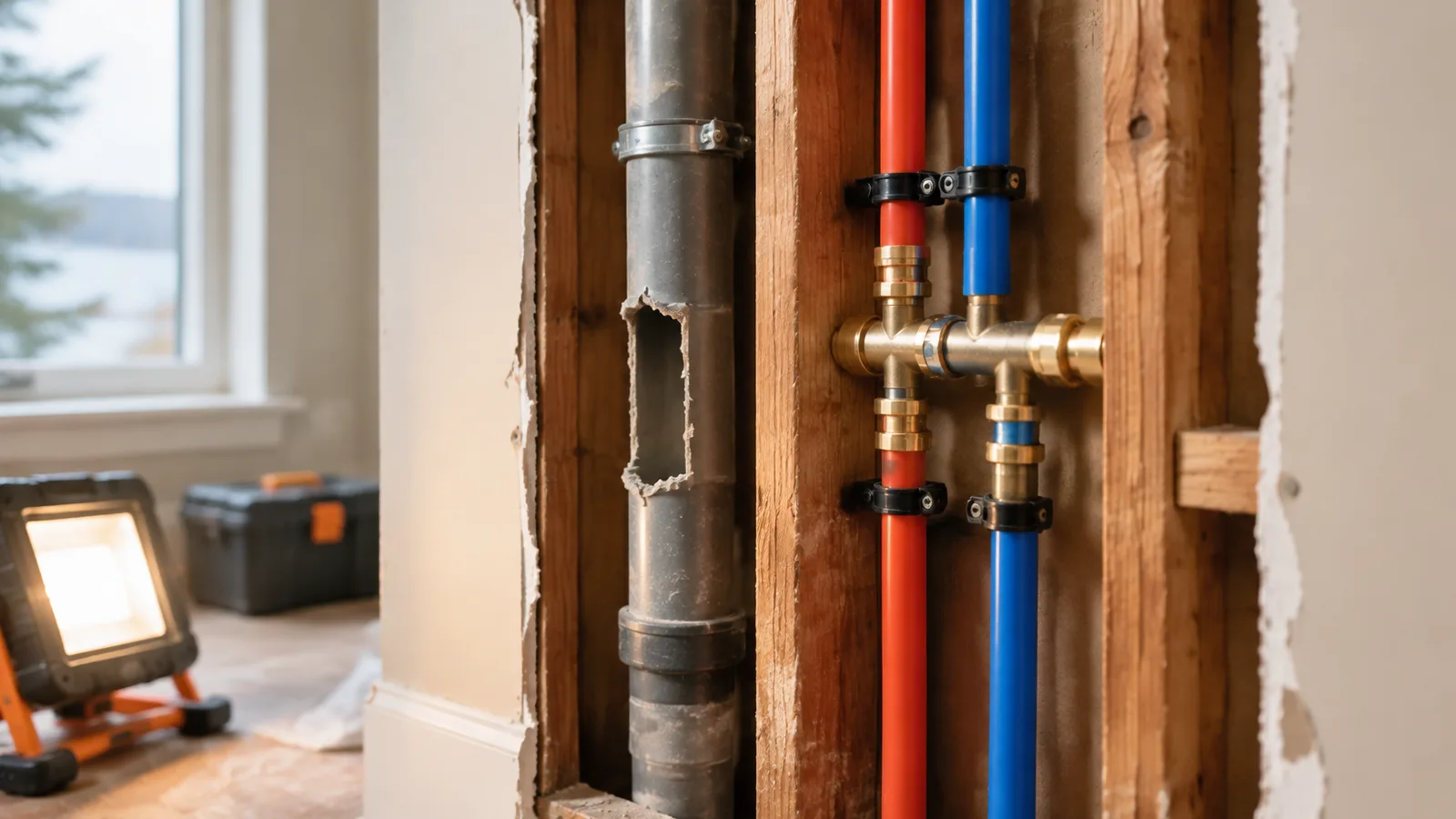
Poly-B is the grey polybutylene supply pipe fitted in BC houses from roughly 1985 to 1997, and a large share of the homes built around Nanaimo in those years still runs on it. You can identify it yourself in about a minute, in the crawlspace or beside the water heater. What to do next depends less on the pipe than on where it has already leaked and what your insurer says at renewal.
Finding out in about a minute
Poly-B does not hide. It is dull grey plastic, flexible enough to bend by hand, usually stamped "PB2110" along its length, and joined with a crimped metal ring over a plastic or copper insert fitting. Rigid copper, white or red-and-blue PEX, and grey CPVC are all something else. The easiest places to look are the ones nobody finished: the crawlspace, the wall behind the water heater, the shut-offs under a bathroom sink.
Five things that tell you it is Poly-B
- Colour and feel — dull grey, flexible, plastic rather than metal.
- A "PB2110" stamp repeated along the pipe.
- Crimped rings at the joints, over an insert fitting rather than a soldered one.
- Age of the house: built or replumbed between about 1985 and 1997.
- Green or white staining and mineral crust around a fitting, which is a joint that has been weeping.
Why it fails, and where it fails first
The pipe is attacked from the inside rather than the outside. Chlorine and other disinfectants in treated water oxidise the material over decades, and the wall loses flexibility long before anything is visible from the room. Heat speeds it up, which is why the runs nearest the water heater and the hot lines generally go first.
The joints are the second half of the story. The acetal plastic fittings and rings used in a lot of Eighties and Nineties installations become brittle with the same exposure, and a crimp that was fine for twenty years can start weeping without warning. That is the characteristic Poly-B failure: not a burst main flooding the kitchen, but a slow drip behind drywall or a crawlspace that smells damp for months before anybody investigates.
The insurance conversation
For most owners on the Island, the conversation starts with an insurance letter rather than a leak. Many Canadian insurers now ask about Poly-B at renewal or when a policy changes hands, and what follows varies by insurer and by what your system actually looks like: a higher premium, a condition to replace it within a set period, a reduced water-damage limit, or a declined application.
Two things are worth doing before you decide anything. Ask your own broker what your policy says about it, in writing, because the answer differs between companies and no contractor can tell you what your underwriter will do. And find out whether your house is fully Poly-B or partly repiped already — plenty of houses here have had a bathroom or a kitchen redone in copper or PEX, and what matters to an insurer is what is left.
Repair one joint, or repipe the house
A single failed fitting in an accessible spot is a repair, and it is the right answer when the rest of the system has no history of leaks and your coverage is not in question. The work is straightforward: cut out the failed joint, replace that section, and leave the rest alone.
The case for a repipe is a pattern rather than one leak. Repeat failures, brittle fittings elsewhere, hot-water runs that have already been patched twice, or an insurer asking for a replacement all point the same way — and at that stage repairing one joint at a time is more expensive over a year than doing it once. A repipe replaces the supply lines with PEX, and the honest part of that conversation is the drywall: the pipe follows the same routes, so some walls and ceilings get opened and patched. What that costs, and where the access points land, comes from a written quote after somebody has been in your crawlspace — not from a phone call.
If you are buying a house here
If you are buying in Nanaimo, Ladysmith, Parksville or anywhere else on this stretch of the Island, the year the house was built tells you whether to look. Home inspection reports usually name the pipe material, and if yours does not, ask — the inspector was in the crawlspace and knows. It is also worth asking the seller whether any part of the house has already been repiped, and whether there is a plumbing invoice to show for it.
None of that makes a Poly-B house a bad buy. It makes it a house with a known item on the list, the way a roof of a certain age is. What you want before the subject removal date is a clear answer on what the insurer will write and what a replacement would involve, so the decision is a number and not a worry.
Frequently asked questions
How do I know whether my house has Poly-B?
Look at exposed pipe in the crawlspace, behind the water heater, or under a bathroom sink. Poly-B is dull grey, flexible plastic, usually stamped "PB2110", and joined with crimped rings rather than soldered fittings. If the house was built or replumbed between about 1985 and 1997 around Nanaimo, it is worth ten minutes with a flashlight.
Is Poly-B banned in British Columbia?
It is not banned, and a house with it is not illegal or unsellable. It stopped being manufactured in North America in the late 1990s and nobody installs it now, so what you have is a material no longer in production, with a known failure pattern, that insurers ask about. Those are practical problems rather than legal ones.
Will my insurer cancel my policy over it?
Policies vary, and no contractor can answer this for your insurer. What we see on the Island ranges from no change at all, through a higher premium or a lower water-damage limit, to a condition that the system be replaced within a set period. Ask your broker what your own policy says before you decide between a repair and a repipe.
Can Poly-B be repaired, or does the whole house have to be repiped?
Both are real options. One failed fitting in an accessible spot is a repair. Repeat leaks, brittle fittings in more than one place, or an insurer asking for replacement make a full repipe the cheaper answer over time. Which one your house needs is a judgement somebody makes after seeing it, and it comes back to you as a written quote.
Does a repipe mean opening up the walls?
Some of them, yes. New PEX follows much the same routes as the pipe it replaces, so access holes get cut where the lines run and are patched afterwards. Where those holes land is part of what the quote describes, and it is worth asking about before the work starts rather than after.
What does a Poly-B leak look like before it becomes obvious?
Usually damp rather than dramatic: a stain on a ceiling below a bathroom, a musty crawlspace, mineral crust or green staining at a fitting, or a water bill that crept up with no change in the household. Poly-B tends to weep at joints long before anything bursts, which is the useful part — it gives you time if somebody looks.
Where we offer this
Ready to get it fixed?
Call now, or send us the details online and we'll follow up.