
Poly-B Pipe Repair in Nanaimo & Vancouver Island
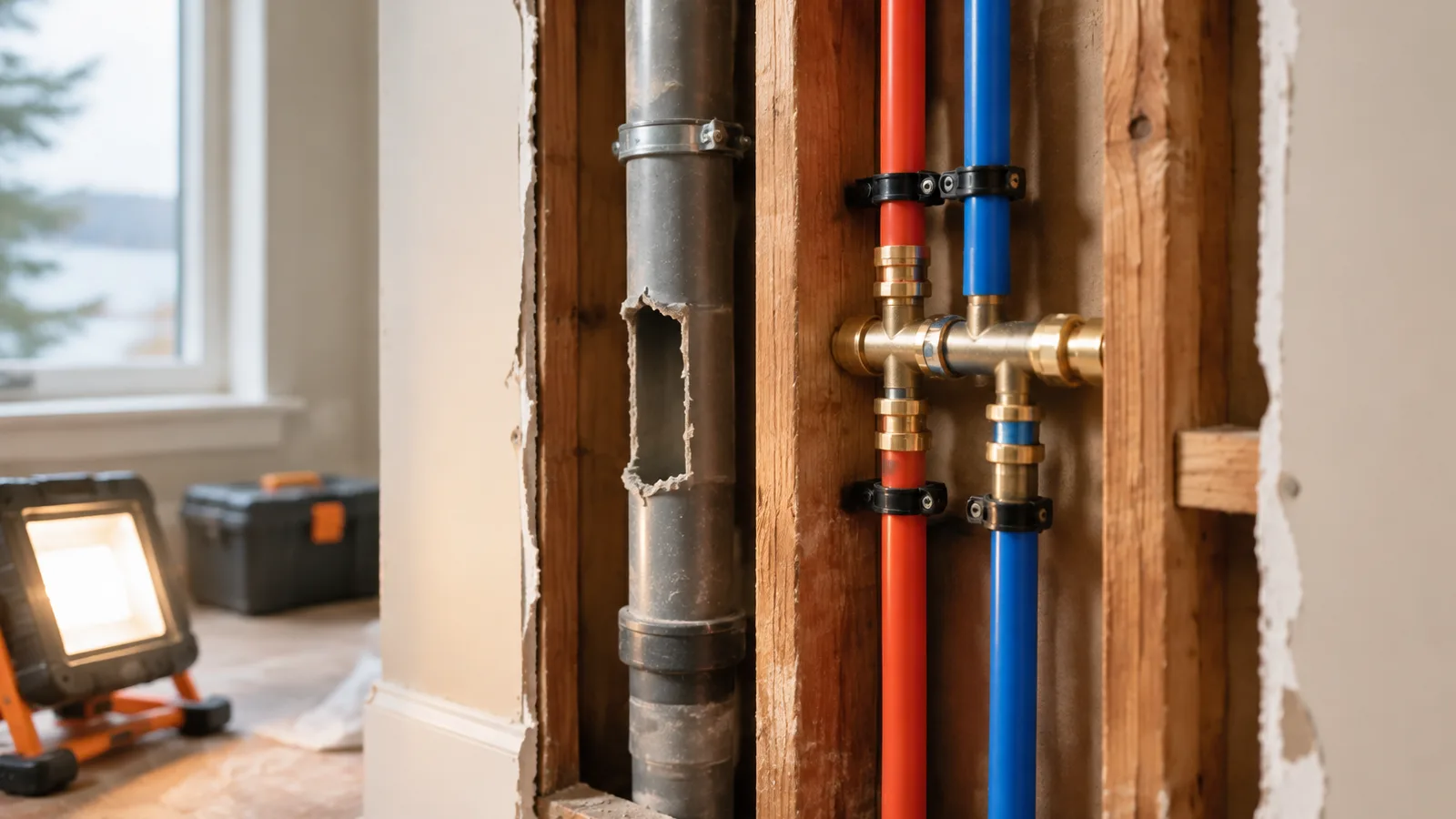
P3 Mechanical & Electrical repairs Poly-B plumbing — the grey polybutylene supply pipe fitted in BC homes from roughly 1985 to 1997 — for houses across Nanaimo and central Vancouver Island. A Poly-B pipe repair at a single accessible fitting is usually done in one visit and costs a fraction of replacing the system, and the figure is fixed by a written quote once the failure has been found rather than guessed over the phone.
How to spot Poly-B, and why insurers ask about it
Identifying it takes about a minute. Look at the exposed pipe in the crawlspace, at the water heater, or under a sink: Poly-B is dull grey plastic, flexible rather than rigid, usually stamped "PB2110" along its length, and joined with crimped rings over plastic or copper insert fittings. Age is the second clue — a large share of the housing built between Nanaimo and Courtenay in those years got it. It rarely bursts mid-run. The failures start at the fittings and at points where chlorinated water and heat have worked on the material from the inside, which is why the classic symptom is a slow drip behind drywall or a crawlspace that smells damp long before anything dramatic happens.
The insurance side is why the conversation usually starts. Many Canadian insurers now ask about Poly-B at renewal or when a policy changes hands, and answers vary from a higher premium to a condition to a declined application, depending on the insurer and on what the system looks like. It is worth asking your own broker what your policy says before deciding between a repair and a repipe, because the honest answer often depends less on the pipe than on what your coverage will look like next year.
What's included
- Identification and a walkthrough of the system, so you know what you have and where it runs
- Repair of leaking crimped joints and failed insert fittings, in place
- Replacement of damaged or degraded sections of Poly-B pipe with PEX
- Reconnection of Poly-B to PEX or copper where a partial replacement meets original pipe
- Checking water temperature and system pressure, the two conditions that shorten Poly-B life
- A clear account of what the system needs now and what a full repipe would involve
Pricing & what's covered
Free estimate
We price the job after an in-home visit, once someone has seen what's there.
- One-year warranty on our labour. Equipment and parts are covered separately, under the supplier's or manufacturer's own warranty.
- We'll go over licensing and equipment with you at the visit.
How it works
Find it — the leak is located and the system inspected, since one failed fitting is worth understanding in the context of the other fittings around it.
Repair or replace the section — a failed joint is cut out and remade properly, with the affected run swapped to PEX where the pipe itself is no longer worth keeping.
Check the conditions — water heater temperature and system pressure get looked at, because heat and pressure are what age the remaining pipe fastest.
Decide what is next — we set out what the rest of the system looks like so you can choose between living with it, repiping in stages, or doing it all at once.
Frequently asked questions
How do I know if the grey pipe in my house is Poly-B?
Poly-B is dull grey, flexible, and joined with crimped metal rings rather than soldered or glued. Most of it carries a "PB2110" stamp along the length, which is the clearest single giveaway. Check the pipe at the water heater or in the crawlspace, and check the build year: BC houses from roughly 1985 to 1997 are the ones to look at.
Will my insurance company cancel my policy because of Poly-B?
Not necessarily, but many insurers now ask about it. Depending on the insurer, having Poly-B can mean a higher premium, a condition attached to the policy, or a declined application — and the answer changes between companies and between renewals. Ask your broker what your specific policy says, because that is the fact that should inform the decision.
Can you just repair the leak instead of repiping the whole house?
Yes, and often that is the right call. A single failed fitting or one damaged run can be repaired on its own, and a system that has been trouble-free otherwise does not need tearing out. What changes the answer is repetition: once fittings start failing in different parts of the house, repeat repairs stop being economical and a partial or full repipe works out cheaper.
Is Poly-B illegal, and do I have to remove it?
It is no longer approved for new installations in Canada, but existing Poly-B is not illegal and there is no requirement to remove it from a house you already own. What drives most replacements is not a rule — it is the failure rate at the fittings and what insurers do with the answer at renewal time.
What makes Poly-B fail in the first place?
Chlorine and other oxidants in treated water attack the material from the inside over the years, and heat accelerates it, so a water heater set high shortens the life of every line downstream of it. The plastic loses flexibility as it ages and micro-cracks form, but the weak points are almost always the joints — the original acetal insert fittings in particular are known for splitting.
How much does a Poly-B repair cost, and how long does it take?
A single failed fitting or a short section is priced as one repair visit, not as a system replacement, and an accessible one is usually done in a single visit. The work carries a one-year warranty on our labour, with the fittings we supply covered by their own manufacturer, and if you would rather price out replacing the system instead, our home repipe page covers that side.
Ready to get it fixed?
Call now, or send us the details online and we'll follow up.